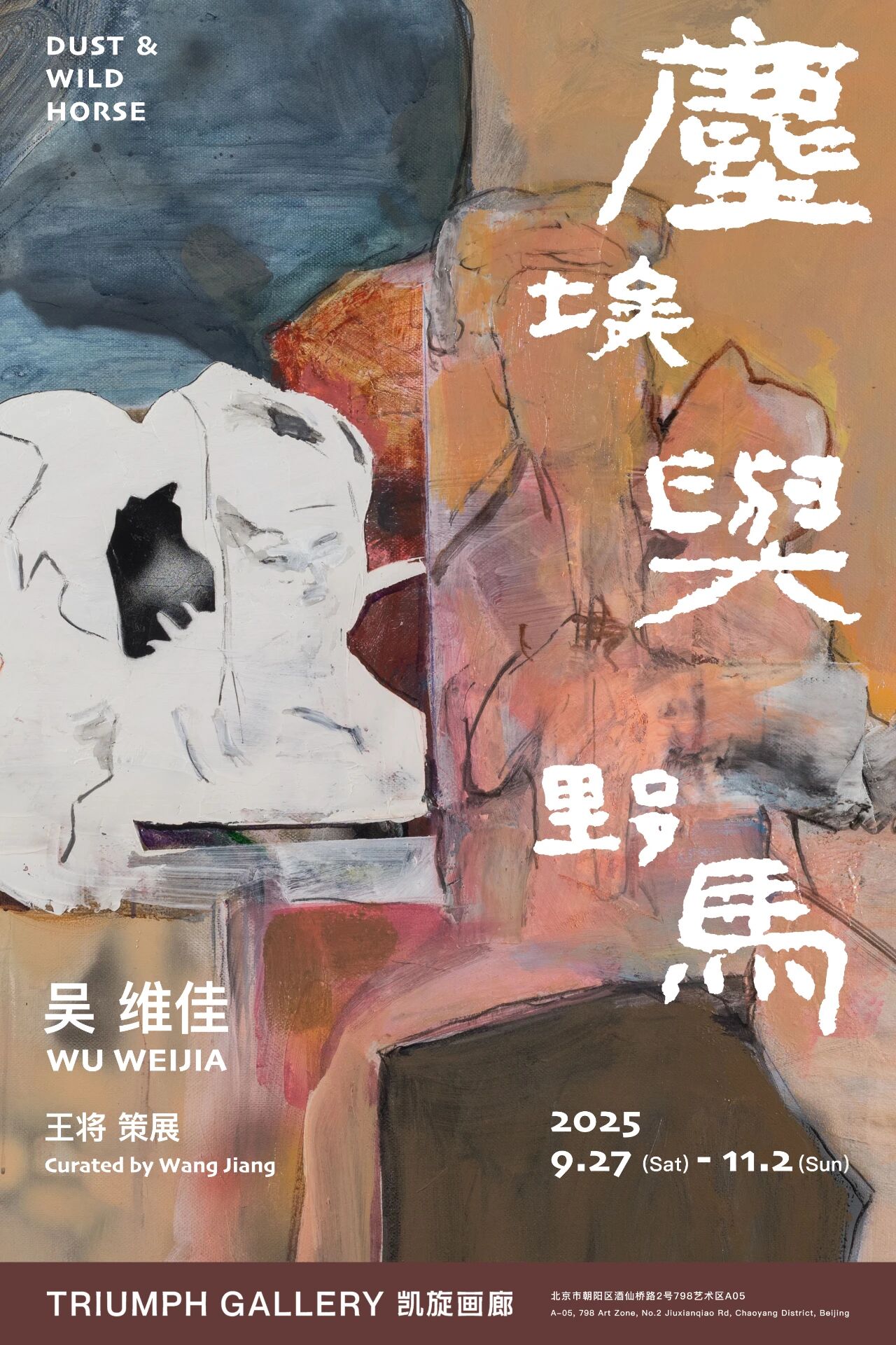
EXHIBITION TITLE 展览名称
尘埃与野马
Dust & Wild Horse
ARTIST 艺术家
吴维佳 Wu Weijia
CURATOR 策展人
王将 Wang Jiang
DURATION 展期
2025.09.27 – 11.02
VENUE 地点
凯旋画廊 TRIUMPH GALLERY
北京市朝阳区酒仙桥路798艺术区2号院A05
A-05, 798 Art Zone, No.2 Jiuxianqiao Rd,
Chaoyang District, Beijing
凯旋画廊将于2025年9月27日至11月2日推出艺术家吴维佳在画廊空间的首次个展《尘埃与野马》,由策展人王将策划。展览集中呈现吴维佳近年来的重要新作,其创作延续并拓展着西方现代与后现代的绘画语言,并在东方哲学中找到了着落点。也正因此,他尤其强调齐物观与禅宗直觉体悟在当代绘画中的实践。在展览筹备之际,王将与吴维佳进行了一次深入对谈,围绕展览“尘埃与野马”及近年创作展开讨论,以下文本为精选出对谈片段。
TRIUMPH GALLERY is pleased to announce the presentation of Wu Weijia's first solo exhibition at the gallery, Dust & Wild Horse, from September 27 to November 2, 2025. Curated by Wang Jiang, the exhibition will focus on presenting a number of important new works by the artist from recent years. His practice continues and expands upon the languages of Western modern and postmodern painting while finding its footing in Eastern philosophy. It is for this reason that he particularly emphasizes the application of the concept of the equality of all things and the intuitive comprehension of Zen in contemporary painting. In preparation for the exhibition, Wang Jiang engaged in an in-depth conversation with Wu Weijia, discussing the themes of Dust & Wild Horse and his recent creative developments. The following text is an excerpt from their dialogue.
王将(以下简称为王):维佳先生,我们先从本次个展同名的作品谈起。《尘埃野马》进一步延续了你近年来一直关注的“齐物”观念,那么具体到这幅画面,你是如何编排那些能识别出的形象呢?在生活中,你是如何和这些形象相遇的?那些不能被识别出来的线条和颜色,又是在一种什么样的状态中被创作出来的呢?
吴维佳(以下简称为吴):其实我每一张画都可以命名为“尘埃野马”,这也是我对世界的基本认知。越来越感到,没有什么事物一定高于其它,也没有什么事情真正更渺小。庄子的“尘埃”在我看来近乎道家的“气”——万物生成消逝,无非是气的聚散,我的画也是如此……我们日常生活除了基本需求,大多接触的是电视、手机、杂志画报这类二手信息。所以素材信手拈来,并无特定选择。
Wang Jiang (hereinafter referred to as Wang): Mr. Wu Weijia, let’s start with the work that shares the same title as this solo exhibition. "Dust, Wild Horse" further extends the concept of "the equality of all things," which you have been focusing on in recent years. So, specifically in this painting, how did you arrange the recognizable images? How do you encounter these images in your daily life? And in what state of mind were the unrecognizable lines and colors created?
Wu Weijia (hereinafter referred to as Wu): In fact, every one of my works could be titled "Dust, Wild Horse," as this reflects my fundamental understanding of the world. I increasingly feel that nothing is inherently superior to anything else, and nothing is truly more insignificant. Zhuangzi’s "dust," in my view, is akin to the Daoist concept of "qi"—the birth and dissolution of all things are merely the coalescence and dispersion of qi, and so are my paintings… In our daily lives, apart from basic needs, much of what we encounter consists of secondary information, such as television, mobile phones, magazines, and pictorials. Thus, the materials I use are readily at hand, with no particular selection process.
尘埃野马 Dust,Wild Horse, 186 × 228 cm
布面油彩 Oil on canvas, 2025
王:作为观看者,其实大家第一眼会习惯性地寻找能够识别的符码。就像前腿抬起的马,画面下部红色的鸟。这些物,和其他那些画布上的莫名的痕迹如何做到“齐”?
吴:我采用的是线性思维,但它是无数不同线索的叠加。观众总想寻找叙事的起点,但我并不以那种方式叙事。我关心的是“当下”,其结果反而是空无的。我更愿意把“广阔天地”留给观者自己去想象。
Wang: As viewers, people instinctively look for recognizable signs at first glance—like the horse with its front leg raised or the red bird at the bottom of the painting. How do these elements coexist in harmony with the other unintelligible marks on the canvas?
Wu: I employ a linear way of thinking, but it’s an accumulation of countless different clues. The audience always seeks a starting point for narrative, yet I don’t construct narratives in that way. What I care about is the "immediate moment," and the result is, instead, a sense of emptiness. I prefer to leave the "vast expanse" to the viewers’ imagination.
喜从天降 A Windfall, 100 × 86 cm
布面丙烯油彩 Acrylic and oil on canvas, 2025
王:有点感兴趣你画中的一些“裂隙”,就是那些白色直线,它们和混沌的线条是完全不一样的,里面有一种人工的,理性的,甚至是机械式的质地。在今年的新作,《喜从天降》里彩色的“裂隙”如光芒一样构成了画面中重要的要素。你如何理解这些裂隙的存在?还有,画中规则的圆点,这些规则的规律的几何形状在画面中意味着什么?
吴:学画之初,我们就被教导要追求“完美”。但这些年我的看法有所改变。我更愿意保留甚至凸显画面中的创伤、断裂与破损——它们其实也是“完美”的一部分。至于是否真有“完美”,那又是另一个问题了。
Wang: I’m somewhat intrigued by the "clefts" in your paintings—those straight white lines. They stand in stark contrast to the chaotic brushstrokes, carrying an artificial, rational, even mechanical quality. In your recent work, "A Windfall", the colorful "clefts" shine like rays of light, becoming a crucial element of the composition. How do you interpret the presence of these clefts? Also, what do the orderly dots and other regular geometric shapes in your paintings signify?
Wu: From the very beginning of our training, we are taught to pursue "perfection." But over the years, my perspective has shifted. I now prefer to preserve—even emphasize—the wounds, fractures, and breaks in a painting. In a way, they are also part of "perfection." As for whether "perfection" truly exists—that’s another question altogether.
人为峰 The Ultimate Summit, 226 × 188 cm
布面油彩 Oil on canvas, 2025
王:那些不规律的痕迹,在之前访谈中谈到的“战争残骸”,这是一种图像的战争吗?是形象的战争吗?是对于越来越清晰确定的现代性图像发动的战争吗?如何理解此处的战争?
吴:如果把作画视为一场战争,那它更像一场遭遇战——随机应变,见招拆招。种什么因,得什么果;遇到什么,就回应什么。固定套路只会陷入程式化,那恰恰是我想要避免的“江湖气”。禅宗讲“破执”,对我而言,破除执念是最好的方法。
Wang: Those irregular traces you've referred to in previous interviews as "the remnants of war"—is this a war of images? A conflict between forms? Is it a rebellion against the increasingly clear and deterministic images of modernity? How should we understand the concept of "war" in this context?
Wu: If we think of painting as a kind of war, it’s more like an encounter battle—improvisational, responding to challenges as they arise. You reap what you sow; you encounter something, and you respond. Sticking to fixed patterns leads to formulaic work, which is exactly the kind of "predictable flair" I want to avoid. Zen Buddhism speaks of "breaking attachments." For me, breaking free from rigid thinking is the best approach.
但丁的小舟 Dante's Canoe, 202× 276 cm
布面油彩 Oil on canvas, 2024
王:看你所用的线条,在另一张《但丁的小舟》中,是一种非常具有你个人特色的造型手法:线条的反复描摹,建构起形象,也消解了形象。可否谈谈这张作品,创作时你对线条是如何运用的?在我的感觉中,甚至线条有时候组织成了一张有弹性的网络——就像《人为峰》里,组成人的线条也组成了山峦的样子。
吴:我喜欢将相似又不同的形象不断重叠,色彩也是如此。我的画一点不抽象,最初甚至是极为具象的——有时还会用投影仪精准描摹。但经过多次的空间叠加、拆解与去中心化处理,画面逐渐抽象化。这正是我想要的结果:从有到无,通过反复过程拓展出更宽阔的视觉空间。我相信,线条、笔触、颜料可以叠加,观念同样可以。我不一定知道最终意义是什么,但我相信反复劳作之后,意义自会显现。
Wang: Looking at your use of lines—in another work, "Dante's Canoe", for instance—there is a highly distinctive stylistic approach: the repeated tracing of lines both constructs and deconstructs the imagery. Could you talk about this piece and how you applied lines during its creation? In my perception, the lines sometimes even organize into an elastic network—much like in "The Ultimate Summit", where the lines that form the figure also shape the mountain.
Wu: I enjoy layering similar yet distinct forms repeatedly, and the same goes for color. My paintings are not abstract at all; in fact, they often start out as highly representational—sometimes I even use a projector for precise outlines. But through multiple layers of spatial overlay, deconstruction, and decentralization, the image gradually becomes abstract. This is exactly the outcome I aim for: moving from presence to absence, expanding a broader visual space through repetitive processes. I believe that just as lines, brushstrokes, and pigments can be layered, so can concepts. I may not always know the final meaning, but I trust that through repeated labor, meaning will reveal itself.
王的故事 The King's Story, 173 × 160 cm
布面油彩 Oil on canvas, 2020
吴:哦,那是早些年的题材。我所画的是我希望见到的虚幻现实,一种特别不真实的现实。可以说那是一种“虚伪现实主义”。
Wang: "Peacock" strikes me as a scene rich with narrative texture. Then there's another piece, "The King's Story," which explicitly references a "story" in its title. Although you often emphasize direct, intuitive engagement with the viewer, I'm still curious about the nature of the "stories" within these scenes.
Wu: Oh, those were themes from earlier years. What I painted was an illusory reality I wished to see—a kind of reality that feels particularly unreal. You could call it "False Realism."
水无意云无心 Drifting Free of Intent, 109 × 221 cm
布面油彩 Oil on canvas, 2020
王:在我看来,《王的故事》《黎明之前》以及《水无意云无心》等那一时间段的作品,都有一个特点,画布往往是不规则的形状。然后不规则的部分之间彼此又存在着一种正负形的关联。就像拼图,相互嵌合,又像拼贴是碎片化的。这种嵌合的关系,不仅体现在画面整体的形状上,也体现在你处理不同形象的手法上。嵌合,为何采用这样的手法?
吴:我对这个问题的理解,恐怕还不如你阐述得精彩。你说得特别到位。那段时期尝试这类作品时,我感到无比自由,也非常快乐。
Wang: In my view, works from that period, such as "The King's Story," "Before the Dawn," and "Drifting Free of Intent," share a common characteristic: the canvases are often irregularly shaped. Moreover, the irregular parts exhibit a positive-and-negative spatial relationship with one another. Like interlocking puzzle pieces or fragmented collages, this interconnectedness is reflected not only in the overall shape of the canvas but also in your approach to rendering different forms. Why did you adopt this technique of interlocking?
Wu: I’m afraid my own understanding of this question may not be as insightful as your articulation. Your description is particularly apt. During that period, when I was experimenting with such works, I felt an immense sense of freedom and great joy.
五音不全 Tone-deaf, 110 × 190 cm
布面油彩 Oil on canvas, 2020
王:我也非常感兴趣类似《五音不全》这幅画里的涂抹痕迹。这种涂抹具有一种侵入性,或者一种破坏性。而这些涂抹的手法,又往往在你描摹和春宫主题的场景里出现。这种涂抹,是某种欲望的表达吗?
吴:《五音不全》中的形象取自《韩熙载夜宴图》中“五女吹箫”的局部,但我并没有画全五个女子,就取名《五音不全》。算是我与顾闳中之间开的一个小小玩笑吧。
Wang: I'm also quite intrigued by the smearing traces in a painting like "Tone-deaf". These smears carry a sense of intrusion, or even destructiveness. Moreover, such smearing techniques often appear in your depictions of scenes with themes of copying or spring palace. Are these smears an expression of a certain kind of desire?
Wu: The imagery in "Tone-deaf" is taken from the segment in The Night Revels of Han Xizai depicting "Tone-deaf," but I didn’t paint all five women, hence the title Tone Deaf. It’s a little joke between Gu Hongzhong and me.
南看北斗 Gazing at North, 73 × 131 cm
布面油彩 Oil on canvas, 2025
王:今年的作品里例如《去马飞》《南看北斗》都是一个特殊的主体处在一个氤氲的氛围中。可识别的主体形象,和周遭的环境产生了很大的张力。这些题目都很有意思,这是某种特殊心境的表达吗?
吴:用这些禅语作为画题,是希望作品能传达出一些禅意。尽管这可能也只是一种妄念。
Wang: In your recent works, such as "Meteoric Rise" and "Gazing at North," a distinct subject is placed within a misty, atmospheric setting. The recognizable subject and its surrounding environment create a strong tension. The titles are also quite intriguing. Are these expressions of a particular state of mind?
Wu: Using these Zen-inspired phrases as titles is my way of hoping the works convey a Zen-like quality—even if that might just be a delusion.
千乘行 Statecraft Journey, 140 × 185 cm
纸本水墨丙烯 Colored ink and acrylic on paper, 2025
王:还有今年的两幅小画,MASK面具,面具很具象,在这个小尺幅中,给面具一个特写。这里面具有什么所指呢?
吴:面具之中其实藏着一幅我模仿小学生课本的插画。我并不清楚这样做会带来什么,还是一贯的“种因不计果”吧。
Wang: There are two small paintings this year, "MASK." The mask is very figurative, presented as a close-up in this small-scale format. What does this mask symbolize?
Wu: Using these Zen-inspired phrases as titles is my way of hoping the works convey a Zen-like quality—even if that might just be a delusion.
White Mask, 50 × 40 cm
布面油彩 Oil on canvas, 2025
王:最后可能是一些相对抽象的问题。人的直觉和感知,其实是一种类似禅宗修炼时候的感知,人与事物的高度亲密状态。这种禅修式的物我关系,是你当下的一种追求吗?作为前辈,你与绘画打了近半个世纪的交道,也见证了整个中国当代艺术的历程。对于今天而言,绘画这种媒介或者艺术门类的“生息”在何处呢?野马和尘埃都是生息流动的样态。
吴:绘画是我认识世界的方式。欢喜与愿望相比,欢喜赢!“野马也,尘埃也,生物之以息相吹也”。
Wang: Finally, a relatively abstract question. Human intuition and perception are akin to the awareness cultivated in Zen practice—a state of profound intimacy between the person and the object. Is this Zen-like relationship between the self and the world something you pursue today? As a senior artist who has engaged with painting for nearly half a century and witnessed the entire trajectory of Chinese contemporary art, where do you see the vitality of painting as a medium or an artistic category today? Both wild horses and dust are forms of flowing vitality.
Wu: Painting is my way of understanding the world. When joy is weighed against ambition, joy prevails! "The steam rising up is like galloping steeds, and the dust moving about is like living things blown by the breath of Nature."
2025.8.26
吴维佳,1960年生于江苏南通,1982年毕业于南京艺术学院美术系油画专业,师承苏天赐。现生活工作于江苏南京,任教于南京师范大学美术学院,长期从事绘画教学及绘画创作。
在吴维佳持续四十余载的艺术生涯里,他致力于不同媒介的绘画实践,跨越油画、中国画、书法等诸多领域,表现出高超的艺术才能和精湛的艺术造诣。其作品被国家大剧院、江苏省美术馆、南京艺术学院美术馆等诸多重要艺术机构收藏。
王将,独立策展人、艺术评论人。他同时是寸止设计(Inch Office )创始人兼视觉总监,并担任四川美术学院硕士研究生导师,及中国当代艺术年鉴特约编委。
从业至今,王将策划了逾百场当代艺术展览,并编辑、设计众多艺术出版物。他的研究与写作聚焦于“中国新绘画”呈现的多元可能性,关注议题包括:具象绘画的复兴与叙事重构;材料实验与新物质主义转向;屏幕文化对架上绘画的渗透;全球化与东方美学的张力;社会运动与集体记忆的视觉化;艺术史谱系的解构与重写。其艺术评论广泛发表于 Artnet、Artnews、Artbaba、ArtAlpha、Hi艺术等专业媒体及各大艺术机构官方平台。他近期的个案评论涉及:袁运生、马可鲁、吴维佳、孟禄丁、王玉平、刘锋植、王音、杨茂源、毛焰、马轲、王迈、黄宇兴、王亚彬、秦琦、陈彧君、关音夫、闫冰、夏禹、高瑀、亓文章、陈柏豪、黄亮、吕松、许宏翔、刘海辰等艺术家。
自2024年起,王将持续进行着对“屏幕一代”的深度访谈、研究与系统梳理工作,试图在此基础上建构后屏幕绘画的核心概念与理论框架。
©文章版权归属原创作者,如有侵权请后台联系