墨方荣幸呈现艺术家贺天琪的个展“奇迹医粮”。此篇为策展人苑芳周与艺术家就本次展览而延伸的对谈。以下对谈中,“苑芳周”简称“Y”,“贺天琪”简称“H”。
对谈 | Talk
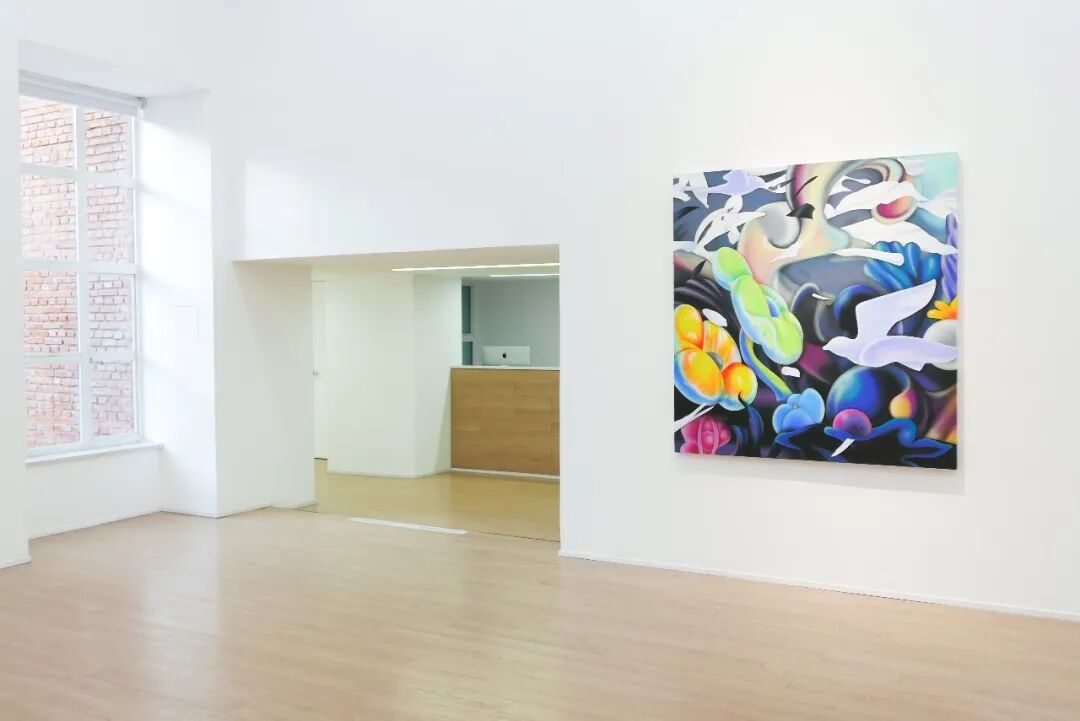
奇迹医粮 Paragranum, 展览现场 Installation View
Y: 相较于此前的创作,此次在墨方展出的作品有一些明显的转变。在此之前你的创作似乎更关注绘画性与色彩强度所引发的心理效应,画面中的对象也往往具有扁平化和符号化的特征。然而你近期作品最突出的一个变化就是引入了具体的形象,并且每个画面都围绕特定形象组建起了复杂的空间关系。这种转变是有意识的还是无意识的?
H: 在这个系列中,我刻意摒弃了之前的浅化处理,并引入了具有神话寓意的象征形象。但我并不想讲述任何特定的寓言。相反,我试图将这些动植物形象嵌入到一个作为“视觉机器”的架构之中。通过构建形与形之间相互衔接、叠加的空间关系,这些具体的形象在画面中具备了超越符号的功能。现在,我更着迷于如何让这些形象在空间中“独立”起来,并同时充当某种总体的一部分。绘画这架“视觉机器”让观众在面对那些看似独立又彼此牵制的形象时,能隐约感受到某种潜藏的秩序在驱动着视觉的运行。这种秩序不是因果关系,而是形象之间的吸引、排斥、嵌构和交错。总之,这种转变是有意识的——我想看看当感性的形象遇上理性的、机械般的空间装配时,会有怎样的视觉力量。这对我来说,是从直觉向系统表达性的一次转变。我希望通过这样的过程,激发出一种令人振奋的效应。形象不过是视觉的引子,那种由形象组装而成、如精密仪器般精准运转的逻辑,才是我真正期望观众能产生共鸣的东西。
Y: 你曾提到创作时对画面中剧场性的考量。剧场性通常意味着设定情节、铺排叙事以及舞台调度。虽然你画面中的形象存在强烈的动态关系,但整体而言却带有恒定的古典意味,并且这些绘画似乎未受叙事的引导,甚至在情节上也是真空的。你究竟是在什么意义上理解这种剧场性的?
H: 我并不依赖叙事驱动创作。对我来说“情节”是一种空间机制。虽然画面中存在某种动态系统,但我试图剔除具体的叙述,努力让这个动态系统在整体上呈现出一种永恒的静谧感。这种静谧感并非来自怀旧,而是源于我一直关注的问题:技术图像的冷感与绘画手工性之间的临界状态。我利用剧场式的舞台调度去模拟一种类似技术监测或机器扫描的冷峻视角,但这种机器视角也与我们熟悉的机器界面不同(值得一提的是,其实监控界面也预设了某种审美化的取景框,服从于某种剧场性)。我认为,挑战惯性的视觉期待可以让复杂的象征关系直接作用于心理机制。你提到的“古典意味”,也许跟我对构图的设计有关。在《Rome-风景》等几件作品里,我确实借鉴了古典绘画那种稳定的几何结构,但同时我也在用各种图层消解、打散这种结构,这种静与动之间的对抗,或许也是剧场性的构成要素。在我看来,剧场性最终指向的是一种“视觉的仪式”,它始终通向某些超越叙事的深层体验。
Rome-风景 Rome-Landscape, 2025, 布面丙烯 Acrylic on canvas, 100x80cm
Y: 许多作品似乎是在一个类似宇宙空间的深邃场景中展开的,选取这种“舞台布景”有什么特殊的用意吗?
H: 这种深邃、类似宇宙的空间布景可以被视作一个“外逸层”(exosphere),它即隔绝了现实场景,又不完全是抽象的虚空。我想在作品中构建这种失重的剧场,因为我希望剥离具体的社会学背景或文化隐喻。所以,这种空间对我来说也不是某种科幻场景,而是一个系统的真空地带。
风暴的阿提卡 Tempete Attica, 2025, 布面丙烯 Acrylic on canvas, 150x120cm
Y: 在这一系列的作品中,色彩的强度和刺激性显著降低了,许多画面中还出现了大面积的黑色。印象中,你曾经好像很抵触使用黑色。
H: 降低强度是为了寻找感知的临界点,过去我关注高强度的色彩刺激,而现在我更倾向于探索导致视觉舒适与麻木的临界点。降低色彩关系的刺激性、引入大面积的黑色,是为了压低画面的“视觉噪音”。当色彩的强度降低时,观众的注意力就从第一眼的感官冲击转向了画面中的动态关系与视觉机制。色彩的使用不再是为了服务于视觉,而是为了调动视觉。
Y: 画面中不定形的黑色物质让我联想到了弗洛伊德所说的趋向于无机状态的“死本能”(Todestrieb)。它们是否在你的剧场中充当了某种危险或毁灭性的否定因素?
H: “否定性的因素”是必要的,因为它同时也具有生产性。我希望让画面中的这些形象具有一种“非生物性的美感”。这种美感本质上就是对生命热度的抽离。画面中那些不定形的黑色物质,确实可以被视为某种危险,它们就像时刻威胁着具体事物的熵增过程,旨在达到一种绝对的静谧。它们虽然暗示着某种毁灭的倾向,但它们同时也提供了一个极其纯粹的底色。正因为有了这种底色,那些动植物的形象才得以像实验室里的高亮样本一样被我们审视观察。当然,这种“否定”并非虚无主义式的放弃,我想尽可能维持并利用这种“危机”,去对冲绘画中易于滑向抒情的趋势。
愈 Heal, 2025, 布面丙烯 Acrylic on canvas, 160x150cm
Y: 这让我想起了格罗伊斯有关美的讨论,在他看来,美恰恰是超越人类的(transhuman),因为无论有机体还是无机物、无论病毒还是宇宙都可以共享“美”这个谓词。回到展览的主题,奇迹医粮(Paragranum)。你最初是在阅读阿甘本的著作时了解到了帕拉塞尔苏斯的同名著作,这本文艺复兴时期的医学著作为何会如此吸引你?
H: 帕拉塞尔苏斯在《奇迹医粮》中强调,医学必须植根于哲学、天文学、炼金术以及对身体-世界关系的整体理解。这种医学观不是技术性操控,而是一种同宇宙整体调谐的方法。这与我试图在绘画中整合技术图像、象征寓意和感知经验的动机相契合:我们如何从机械的视觉刺激中回收图像,让它重新作为经验在观看者的身体上生效?在这个层面上,阿甘本的论述对我很有启发。阿甘本在解读帕拉塞尔苏斯时反复强调一个核心问题:事物和语言之间的签名关系。他认为,语言是对世界的再制,是一种将流动的生命力固化的操作。而艺术可以把我们带回到前语言的开放状态。我的画中的确有很多动植物的形象,但它们首先涉及一种异质性的感知转化。在我们面对那些异于认知的状态时,我们总是首先用语言去捕捉它们,但这个过程本身就是一种主体性的投射。因此,我画面中的那些嫁接、变异的形象主要是一种消融预设的措施。借用“奇迹医粮”这一概念,我希望图像可以直接作用于人类的感知系统,在原有的认知结构上撕开裂口,让某种异质的生命力渗入。
奇迹医粮 Paragranum, 帕拉塞尔苏斯 Paracelsus, 赫利孔工作室 Helikon Stúdió, 1989
Y: “Paragranum”的词根“granum”有谷物、药丸、基础的意思,而“Para”这一前缀的字面意思就是“超越、在…之外”。帕拉塞尔苏斯的医学思想有着浓重的神学底色;然而在你的作品中,超越性的“奇迹”似乎并非来自上帝的先验处方,而是扎根于自然的隐秘本能中。在我看来,画面中的各种动物形象似乎暗示着某种自然的疗养本能,你能否展开谈谈这批作品中的动物形象?
H: 在帕拉塞尔苏斯那里,“Para-”的确指向一种属于神学秩序的超越性:医学的根基不只是物质性的药物,而是来自上帝、宇宙与自然法则之间的对应关系。但在我的创作中,这种“超越”被重新置换了方向——它不再指向神圣的外部秩序,而是一种内源性的、扎根于生命的本能。我之所以反复使用动物形象,正是因为它们拥有最原始的生存直觉与韧性,因此携带着一种前文化的生命强度。如果在《奇迹医粮》的语境中,“granum”意味着最基础、不可再分的药性单位,那么动物形象在我这里恰恰是这种基础中最具活性的成分。它们不依赖语言、伦理或象征系统,而是通过呼吸、扩张与运动来生存。这种不经中介的存在方式本身就是一个“奇迹”——它不需要任何处方,而是在极端环境中探索意外的联结,这也是生命超越既定框架的潜能。在我的画面中,动物形象往往被组装进一架复杂的图像机器中,它们的“生物性热度”与“技术图像的冷感”在画面中相互抵触、相互反应。在某种程度上,这些动物仿佛成为了传感器——它们停顿、忍耐、逃逸,进而调节我们的姿态与感知。当技术图像不断削弱感官的阈值、抽空经验的内容时,这种扎根自然、甚至带有逃生与防御意味的本能,反而是最可靠的支点。
明室 Light chamber, 2025, 布面丙烯 Acrylic on canvas, 150x120cm
Y: Compared to your previous works, the pieces exhibited at Mocube Gallery show some noticeable shifts. Earlier, your creations seemed to focus more on the psychological effects triggered by painterly qualities and color intensity, and the objects in your works often featured flattened and symbolic characteristics. However, one of the most prominent changes in your recent works is the introduction of specific forms, with each piece constructing complex spatial relationships around these forms. Is this shift intentional or unconscious?
H: In this series, I deliberately abandoned the shallow treatment of my earlier works and introduced symbolic forms with mythological connotations. However, I did not intend to tell any specific fables. Instead, I aimed to embed these animal and plant forms into a structure that functions as a "visual machine." By constructing spatial relationships where forms interconnect and overlap, these specific images go beyond mere symbols in the composition. Now, I am more fascinated by how to make these forms stand "independently" within the space while simultaneously acting as part of a greater whole. This "visual machine" of painting allows viewers to vaguely sense an underlying order driving the visual experience when faced with seemingly independent yet interconnected forms. This order is not about causality but the attraction, repulsion, integration, and interweaving between forms. In short, this shift is intentional—I wanted to explore the visual power that arises when perceptual forms meet rational, almost mechanical spatial arrangements. For me, this is a transition from intuition to systematic expression. I hope this process can evoke an exhilarating effect. The forms are merely visual cues; the logic of their assembly, which operates with the precision of a finely tuned instrument, is what I truly hope resonates with viewers.
Y: You have mentioned considering theatricality in your work. Theatricality typically implies setting plots, arranging narratives, and stage choreography. Although the forms in your works exhibit strong dynamic relationships, the overall impression carries a constant classical undertone. Moreover, these paintings do not seem to be guided by narrative and even appear void of plot. In what sense do you understand this theatricality?
H: I do not rely on narrative to drive my creations. For me, "plot" is a spatial mechanism. Although there is a dynamic system within the composition, I attempt to eliminate specific narration, striving for this dynamic system to present an overall sense of eternal tranquility. This tranquility does not stem from nostalgia but from a question I have long been concerned with: the critical state between the coldness of technical images and the handmade nature of painting. I use theatrical stage choreography to simulate a cold, machine-like perspective, such as technical monitoring or scanning. However, this machine perspective also differs from the machine interfaces we are familiar with (it is worth mentioning that monitoring interfaces also presuppose a certain aesthetic framing, subject to a kind of theatricality). I believe that challenging habitual visual expectations can allow complex symbolic relationships to directly impact psychological mechanisms. The "classical undertone" you mentioned might be related to my composition design. In works like "Rome-Landscape," I indeed drew inspiration from the stable geometric structures of classical painting, but I also used various layers to dissolve and scatter this structure. The tension between stillness and movement may also be a component of theatricality. In my view, theatricality ultimately points to a "visual ritual," always leading to deep experiences beyond narrative.
Y: Many works seem to unfold within a deep, space-like setting. Is there a particular intention behind choosing this kind of "stage backdrop"?
H: This deep, space-like backdrop can be seen as an "exosphere"—it isolates real-world scenes while not being entirely an abstract void. I wanted to construct this weightless theater in my works because I aimed to strip away specific sociological contexts or cultural metaphors. Therefore, this space is not a sci-fi setting for me but a vacuum zone within a system.
Y: In this series, the intensity and stimulation of colors have significantly diminished, and large areas of black appear in many compositions. I recall that you once seemed resistant to using black.
H: Reducing intensity is about finding the threshold of perception. In the past, I focused on high-intensity color stimulation, but now I am more inclined to explore the critical point between visual comfort and numbness. Diminishing the stimulation of color relationships and introducing large areas of black are meant to lower the "visual noise" in the composition. When color intensity is reduced, the viewer's attention shifts from the initial sensory impact to the dynamic relationships and visual mechanisms within the work. The use of color is no longer to serve vision but to mobilize it.
Y: The amorphous black substances in your works remind me of what Freud referred to as the "death drive" (Todestrieb), which tends toward an inorganic state. Do these substances serve as some kind of dangerous or destructive negative element in your theater?
H: "Negative elements" are necessary because they are also productive. I want the forms in my works to possess a kind of "non-biological beauty." This beauty essentially involves the removal of life's warmth. The amorphous black substances in the compositions can indeed be seen as a kind of danger, like an entropic process constantly threatening specific entities, aiming to achieve absolute tranquility. Although they hint at a destructive tendency, they also provide an extremely pure background. It is precisely because of this backdrop that the animal and plant forms can be examined like high-contrast samples in a laboratory. Of course, this "negation" is not a nihilistic abandonment. I aim to maintain and utilize this "crisis" to counteract the tendency of painting to slide toward lyricism.
Y: This reminds me of Groys' discussion of beauty, where he argues that beauty is precisely transhuman because both organic and inorganic entities—whether viruses or the universe—can share the predicate "beauty." Returning to the exhibition's theme, "Paragranum" (Miracle Medical Grain). You first learned about Paracelsus' work of the same name through reading Agamben. Why were you so drawn to this Renaissance medical treatise?
H: In "Paragranum," Paracelsus emphasized that medicine must be rooted in philosophy, astronomy, alchemy, and a holistic understanding of the body-world relationship. This medical perspective is not about technical manipulation but a method of harmonizing with the cosmos as a whole. This aligns with my motivation to integrate technical images, symbolic connotations, and perceptual experiences in painting: How can we reclaim images from mechanical visual stimuli and allow them to function again as experiences in the viewer's body? In this regard, Agamben's discussion has been enlightening. In interpreting Paracelsus, Agamben repeatedly emphasizes a core issue: the signature relationship between things and language. He argues that language is a reproduction of the world, an operation that solidifies the flow of life force. Art can return us to a pre-linguistic state of openness. There are indeed many animal and plant forms in my paintings, but they first involve a heterogeneous transformation of perception. When we encounter states beyond our cognition, we always try to capture them with language, but this process itself is a projection of subjectivity. Therefore, the grafted and mutated forms in my works are primarily a measure to dissolve presuppositions. Borrowing the concept of "Paragranum," I hope that images can directly act on the human perceptual system, tearing open gaps in existing cognitive structures and allowing a heterogeneous vitality to seep in.
Y: The root "granum" in "Paragranum" means grain, pill, or foundation, while the prefix "Para" literally means "beyond" or "outside of." Paracelsus' medical thought carries strong theological undertones; however, in your works, the transcendent "miracle" does not seem to come from God's preordained prescription but is rooted in the hidden instincts of nature. To me, the various animal forms in the compositions seem to suggest some kind of natural healing instinct. Could you elaborate on the animal imagery in these works?
H: In Paracelsus' view, "Para-" indeed points to a transcendence within a theological order: the foundation of medicine is not merely material drugs but the correspondence between God, the cosmos, and natural laws. However, in my work, this "transcendence" is redirected—it no longer points to a sacred external order but to an endogenous instinct rooted in life itself. I repeatedly use animal forms precisely because they possess the most primitive survival instincts and resilience, carrying a pre-cultural intensity of life. If, in the context of "Paragranum," "granum" represents the most basic, indivisible unit of medicinal potency, then animal forms in my work are the most active components of this foundation. They do not rely on language, ethics, or symbolic systems but survive through breathing, expansion, and movement. This unmediated way of existence is itself a "miracle"—it requires no prescription but explores unexpected connections in extreme environments, reflecting life's potential to transcend established frameworks. In my compositions, animal forms are often assembled into complex image machines, where their "biological warmth" and the "coldness of technical images" clash and interact. In a sense, these animals act like sensors—they pause, endure, escape, and thus modulate our posture and perception. When technical images continually weaken sensory thresholds and empty experience of its content, this instinct rooted in nature, even carrying connotations of escape and defense, becomes the most reliable anchor.
关于艺术家 Artist Bio
贺天琪 He Tianqi(b.1990), 2016年于西安美术学院获硕士学位,现工作、生活于西安。贺天琪的绘画源于对物体形象的心理表征的采集,结合数字图像的技术特征,以征象、冥想空间和物化系统昭示自身的视网膜修辞。他曾为法国巴黎中国文化中心受邀访问学者。其作品曾于上海chiK11美术馆,OCAT美术馆,上海余德耀美术馆,北京、瑞士、英国、荷兰等多地艺术空间和美术馆展出。
He Tianqi(b.1990) graduated with a master's degree from the Xi'an Academy of Fine Arts in 2016 and is currently based in Xi'an, where he works and lives. He Tianqi's paintings originate from the collection of mental representations of object imagery, combining the technical characteristics of digital images to reveal his own retinal rhetoric through signs, meditative spaces, and materialized systems. He was an invited visiting scholar at the China Cultural Center in Paris, France. His works have been exhibited at numerous art spaces and museums, including the chi K11 Art Museum in Shanghai, OCAT Museums, the Yuz Museum Shanghai, as well as venues in Beijing, Switzerland, the United Kingdom, and the Netherlands.
关于策展人 Curator Bio
苑芳周,本科毕业于西安美术学院设计系,现于同济大学哲学系攻读博士学位,研究方向为美学、尼采哲学。
©文章版权归属原创作者,如有侵权请后台联系