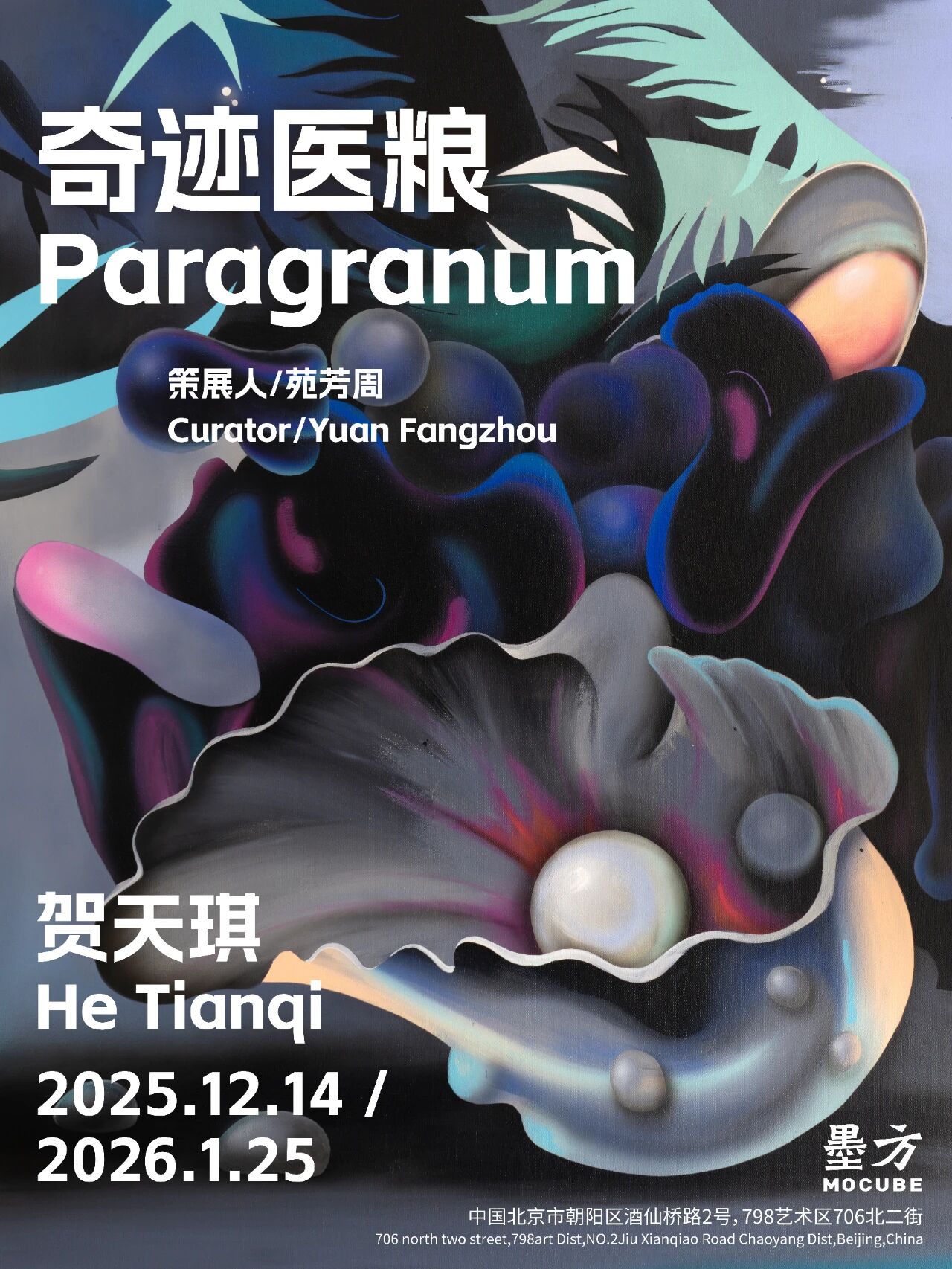
愈 Heal, 2025, 布面丙烯 Acrylic on canvas, 160x150cm
“技术图像是致幻的(psychedelic)”,它带来了一种“类似药物所引起的自由,一种可以无视客观世界、无视诸条件或事物所组成之世界的自由——一种致幻的自由。” [1] 弗卢塞尔(Flusser)在上世纪80年代写下的这一预言,如今已然应验:技术图像对人类感知的降解和麻醉已经造成了“注意力的普遍失序”,而压抑-发泄、成瘾-戒断的恶性循环似乎成了我们难以摆脱的困境。在当前的技术环境下,远程通信者对任何可能的图像都已建立起极高的耐受性,而“当代艺术”似乎也只能在他们指尖即时的自动操作下不断化为技术图像的养料。
Rome-风景 Rome-Landscape, 2025, 布面丙烯 Acrylic on canvas, 100x80cm
贺天琪的近作表面上似乎就是在解析这一粒子化的技术图像宇宙:在《Rome-风景》、《明室》等画作局部裸露出的锯齿和马赛克斑点,便可视作对技术图像粒子态的一种解剖,这不仅暗示着绘画在当前媒介中的可解码性和可组装性,而且也暴露出图像本身的脆弱与虚空。除此之外,这些绘画的用色也让我们体验到了那种“致幻的自由”:大面积的黑色与紫色、钴蓝、玫红混合出形形色色介于有机和无机之间的形体:植物、耳廓、眼睛、触角互相嫁接、彼此转化,生命与非生命的界限也趋向消弭。尽管如此,这些阴森叵测的致幻图像却朦胧地向我们透露出一系列有关治疗的寓言。
明室 Light chamber, 2025, 布面丙烯 Acrylic on canvas, 150x120cm
在画作《明室》中,四处流动的黑色物质仿佛暗示着空间的紊乱与危险的随机性,然而其中形似狐狸或犬类的动物形象却显露出古希腊雕像般泰然自若的神情。动物识药学(zoopharmacognosy)的研究表明,犬科动物在遭受寄生虫和有毒物质侵害时可以凭借本能寻觅草药进行自我治疗。也许正是这种对生物“疗养智慧”和自然本能的信赖让画作具备了一种单纯而静穆的力量。值得注意的是,贺天琪画作中的动物形象并未呈现出捕猎或追踪的姿态;相反,这些动物不是在摸索试探,就是在逃逸漫游。在《The north face》中,两只猿猴手尾衔接,在一个了无生机的严酷环境中试图探索一线生机。虽然猿猴的形象不具备任何体积与面部表情,但他们手尾“缠握”所形成的牢固锁链却触动人心。“人类之手善于遏制即时的世界,将其带入停滞”, [2] 而动物之手则善于拉拢团结。正如哈拉维所言:“地球上的生物都善于缠握(prehensile)、善抓机会,随时准备把不太可能的伙伴联结进某种全新的共生体。” [3]
北壁 The north face, 2025, 布面丙烯 Acrylic on canvas, 100x80cm
尼采曾言:“毒药能使虚弱者毁灭,而对于强者来说则意味着强化剂”, [4] 尼采所谓的强者与其说是一种技术化的超人,不如说是一种像其他物种学习的大地居民。查拉图斯特拉自始至终都深爱着他的动物们,他甚至将自己的健康归功于动物们的陪伴:“我的动物们,告诉我吧:是不是这些高等人全体——也许都散发出不好的气息?呵,我周围纯净的气息啊!现在我才知道和感觉到,我是多么爱你们,我的动物们。” [5] 在此意义上,贺天琪的绘画也是一种“缠握”住观众、将其从技术图像的浊流拉回到那一更大共生体的尝试。
文/ 苑芳周
[1] Vilém Flusser, Into the Universe of Technical Images, trans by Nancy Ann Roth,University of Minnesota Press2011, p138.
[2] ibid., p8.
[3] Donna Haraway, The Companion Species Manifesto, Prickly Paradigm Press 2003, p32.
[4] 尼采:《快乐的科学》孙周兴译, 上海人民出版社2022年,Ⅰ §19.
[5] 尼采:《查拉图斯特拉如是说》孙周兴译, 上海人民出版社2016年, Ⅳ, 74.“忧郁之歌”。
洗礼 Ablution, 2025, 布面丙烯 Acrylic on canvas, 100x80cm
"Technical images are psychedelic," offering a "drug-induced kind of freedom, a freedom to disregard the objective world, the world of conditions or things—a hallucinatory freedom." [1] This prophecy, written by Flusser in the 1980s, has now come to pass: the degrading and numbing effect of technical images on human perception has led to a "universal disorder of attention," and the vicious cycle of repression-release, addiction-withdrawal seems to have become a dilemma we can hardly escape. In the current technological environment, remote communicators have developed an extremely high tolerance for any possible image, while 'contemporary art' seems only capable of constantly turning into fodder for technical images under the instant, automatic operations at their fingertips.
On the surface, He Tian-qi's recent works seem to dissect this atomized universe of technical images: the exposed jagged edges and mosaic spots in sections of paintings such as "Still Life" and "Light Chamber" can be seen as an anatomical study of the particulate state of technical images. This not only hints at the decodability and assemblability of painting within the current media landscape but also exposes the inherent fragility and emptiness of images themselves. Furthermore, the color palette of these paintings allows us to experience that very "hallucinatory freedom": expansive areas of black, blended with shades of purple, cobalt blue, and rose pink, give form to a variety of organic and inorganic shapes—plants, auricles, eyes, and antennae grafted onto one another, transforming interchangeably. The boundary between life and non-life gradually dissolves. Yet, amidst these eerie and unpredictable psychedelic images, a series of therapeutic allegories faintly emerges.
In the painting "Light Chamber," flowing black substances seem to suggest spatial disorder and hazardous randomness. However, the animal figures resembling foxes or canines reveal expressions of serene composure, reminiscent of ancient Greek statues. Research in zoopharmacognosy shows that canines, when afflicted by parasites or toxins, can instinctively seek out medicinal herbs for self-treatment. Perhaps it is this very trust in the "healing wisdom" of organisms and natural instincts that imbues the painting with a simple yet solemn power. Notably, the animal figures in He Tian-qi's works do not exhibit hunting or tracking postures; instead, they are either tentatively probing or escaping and wandering. In "The North Face," two apes, connected hand to tail, strive to explore a glimmer of hope in a harsh and lifeless environment. Although the apes lack volume and facial expressions, the firm chain formed by their "grasping" hands and tails is profoundly moving. "The human hand is adept at suppressing the immediate world, bringing it to a standstill," [2] while the animal hand excels in rallying and uniting. As Haraway notes: "Earthly beings are skilled at prehensile, opportunistic connections, always ready to weave unlikely partners into some new symbiosis." [3]
Nietzsche once said, "The poison from which the weaker nature perishes strengthens the strong man—and he does not call it poison," [4] Nietzsche's so-called "strong" is less a technological superman than an earth-dweller who learns from other species. Zarathustra loved his animals deeply from beginning to end, even attributing his health tothe companionship of his animals: "Tell me, mine animals: these higher men, all of them—do they perhaps not SMELL well? O pure odours around me! Now only do I know and feel how I love you, mine animals." [5] In this sense, He Tian-qi's paintings are also an attempt to "grasp" the viewer, pulling them from the murky currents of technical images back into that greater symbiosis.
Text/ Yuan Fangzhou
[1] Vilém Flusser, Into the Universe of Technical Images, trans. Nancy Ann Roth, University of Minnesota Press, 2011, p. 138.
[2] Ibid., p. 8.
[3] Donna Haraway, The Companion Species Manifesto, Prickly Paradigm Press, 2003, p. 32.
[4] Friedrich Nietzsche, The Gay Science, trans. Sun Zhouxing, Shanghai People's Publishing House, 2022, I §19.
[5] Friedrich Nietzsche, Thus Spoke Zarathustra, trans. Sun Zhouxing, Shanghai People's Publishing House, 2016, IV, 74. “The Song of Melancholy.”
关于艺术家 Artist Bio
贺天琪 He Tianqi(b.1990), 2016年于西安美术学院获硕士学位,现工作、生活于西安。贺天琪的绘画源于对物体形象的心理表征的采集,结合数字图像的技术特征,以征象、冥想空间和物化系统昭示自身的视网膜修辞。他曾为法国巴黎中国文化中心受邀访问学者。其作品曾于上海chiK11美术馆,OCAT美术馆,上海余德耀美术馆,北京、瑞士、英国、荷兰等多地艺术空间和美术馆展出。
He Tianqi(b.1990)graduated with a master's degree from the Xi'an Academy of Fine Arts in 2016 and is currently based in Xi'an, where he works and lives. He Tianqi's paintings originate from the collection of mental representations of object imagery, combining the technical characteristics of digital images to reveal his own retinal rhetoric through signs, meditative spaces, and materialized systems. He was an invited visiting scholar at the China Cultural Center in Paris, France. His works have been exhibited at numerous art spaces and museums, including the chi K11 Art Museum in Shanghai, OCAT Museums, the Yuz Museum Shanghai, as well as venues in Beijing, Switzerland, the United Kingdom, and the Netherlands.
关于策展人 Curator Bio
苑芳周,本科毕业于西安美术学院设计系,现于同济大学哲学系攻读博士学位,研究方向为美学、尼采哲学。
Yuan Fangzhou graduated with a bachelor's degree from the Department of Design at Xi'an Academy of Fine Arts and is currently pursuing a doctoral degree in the Department of Philosophy at Tongji University, with research interests in aesthetics and Nietzschean philosophy.
©文章版权归属原创作者,如有侵权请后台联系