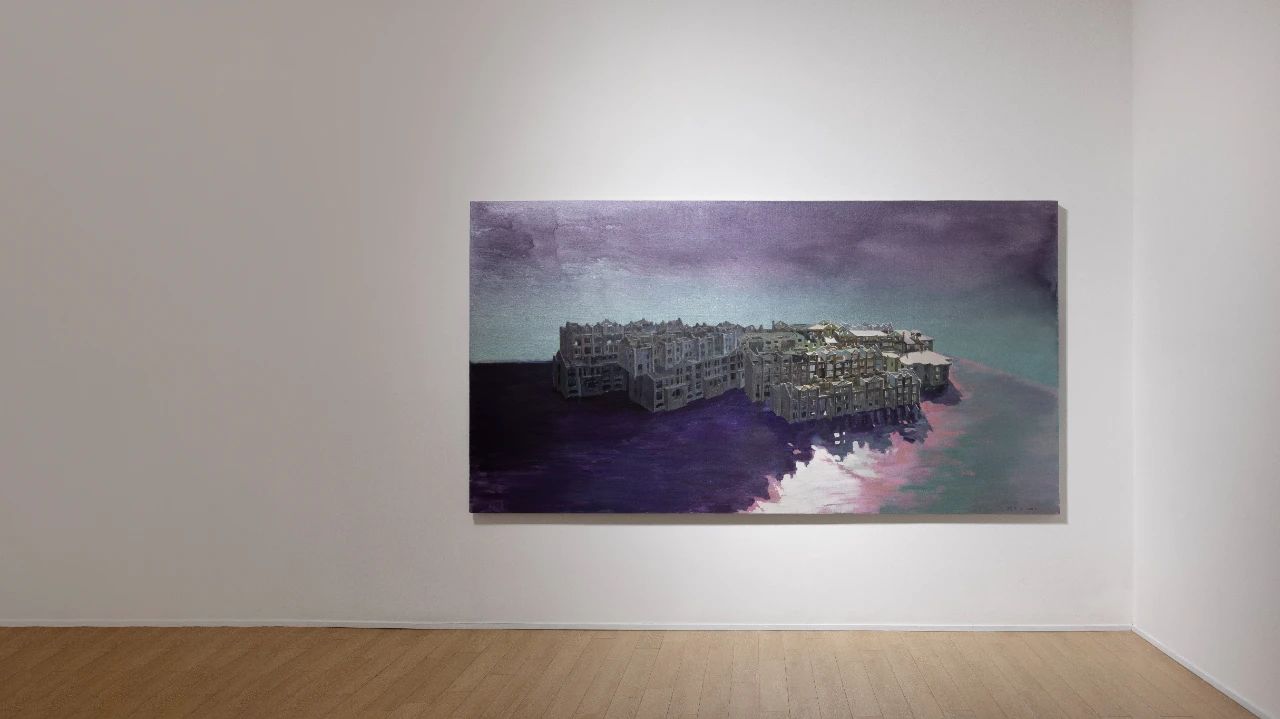
墨方荣幸呈现艺术家李易纹在墨方的第三次个展“世界岛”,此篇为墨方与艺术家李易纹就本次展览而延伸的书面交流,以下访谈中,“墨方”简称“M”,“李易纹”简称“L”。
访谈 | Talk
世界岛-1,布面丙烯,170×320cm,2025
World Island-1, Acrylic on canvas, 170×320cm, 2025
M:这是你在墨方的第三次个展,从“湍流”“共时场”到如今的“世界岛”,展览题目似乎总带有某种矛盾的诗意——既指向现实的庞杂,又渗透个体的孤独。能否先谈谈“世界岛”这一概念的误读与转化?你是如何将地理政治学的宏大词汇,抽离为一种个人化的精神图景?
L:“世界岛”原本是个地缘政治学概念,本来也是我陌生的领域,但不知道什么时候随着我平时杂乱的阅读引发了我的兴趣,开始想去了解,就买了那本《历史的地理枢纽》翻阅。更随着阅读的拓展,了解到这个地缘竞争理论对随后的两次世界大战历史走向,今日世界格局面貌的影响,既感觉遥远又感到残酷;既陌生又似乎和我们每个现在的人都有一丝联系。我们哪个人不是宏大社会图景里的微小个体,不是茫茫历史洪流里平凡的沙粒?之所以强调是“误读”是因为一个画画的人即使读了几本哲学、文学、甚至社会学、物理学的图书和论著也不见得完全理解里面真正的含义,有时来源于误解的想象力也许就是一种创造。作为一个画画的人面对的是这个词语本身带给我一种通感式的想象,每次这个词在脑中闪过都让我感到一种孤独和荒寂,我把这种心理状态想象成“岛–世界”的二元对应关系,岛对应我们每个个体封闭又丰饶的内心,“世界”就像我们生存的汪洋现实,纷繁复杂、斑驳残酷,有时不可理解。
L:我平常生活在北京的城市边缘地带,这些年也去过很多其它城市乡镇的边缘地带,我感觉到我们像是被城市化进程驱赶着向前,这些年烂尾的各种建筑物既像是这一进程里的bug又像是纪念碑,而我的创作一直是想表达自己与处身其中的这个社会的关系,尽管它给我们带来的更多是一种挤压感和无力感,但也正是这种感受铸造了我所有作品的荒凉的气息和底色。谈到绘画语言和风格,我希望在我的作品里它不是来自对他人的模仿或是刻意寻找的,而是自然而然的从我对生存的这个世界的现实和心理感受里生长出来的,所以在绘画的过程里,如何注入自己涌动的情绪、投射自己的呼吸是最重要的,像是古人说过的“胸中有丘壑,下笔才有气象万千。”而有些东西是无法用语言来传达的,只能寄望每个看画的人打开自己的感官通道,在具体的每一幅绘画面前感受。
世界岛-2,布面丙烯,190×280cm,2025
World Island-2, Acrylic on canvas, 190×280cm, 2025
L:我记得很早以前看过吴冠中先生写的一篇好像叫“风筝不断线”的文字就是讲艺术的形式内容与现实生活的联系,无论怎样的主题总割不断与现实的一线联系,以前几个系列基于对记忆与时间的发掘,和这次更偏向从现实中感知的系列都是不同的感受现实的途径,都在丰富着个人的表达角度。“依存式的抵抗”也是说我们每个人都对现实感到不满与不甘,这或许也是我表达欲和创造力的来源,以前有句话讲“国家不幸诗家幸”,我们既不满于现状,却又依赖于这种对现状的感受推进自己的创作。
山巅之城-s,布面丙烯,42×25cm,2025
City upon a Hill – s, Acrylic on canvas, 42×25cm, 2025
L:冷色调跟我喜欢的气质有关,而我所有的色彩都使用金属色,是我在长期的实践中发现金属色能画出我想要表达的那种“回忆的光晕”。我的作品里不存在叙事,悲观与乐观我相信都是天性,都是刻画在基因里的,周围的朋友们都会觉得我是个挺乐观的人,但是真正的性格底色往往都深藏在表象之下,这也许是人性复杂的体现吧。
双循环-1,布面丙烯,155×255cm,2024
Dual Circulation-1, Acrylic on canvas, 155×255cm, 2024
L:屏幕式和剧场式都和作品的内容有关,以前我的老师辈的画家画画时,无论用水墨画写意的花草、山石、皴擦点染,还是用素描油彩画人物、风景、熟悉透视解剖、营造空间,“写生”的概念便是我们获取形象、图像、素材必不可少的手段。这其中也贯穿着对整个中西美术史的不断了解,中国画自魏晋隋唐到明清的状物写心,寄兴遣怀;西方绘画文艺复兴以来一直到印象派再至塞尚对自然的再现与重构,无不依赖对自然之物的直接观察,写生便成为了获得一手资料和感受的主要途径。而现在我们获取信息和图像的主要方式是通过一块块或大或小的电子屏幕。这也改变了我们在创作时获取信息和形象的方法,我们这一代人是随着互联网的应用和智能手机的普及一起成长的,我们更多的通过屏幕来观察世界,这自然也会影响到绘画的内容、色彩和视觉呈现的形式吧。很多时候我会在处理色彩关系时带入这种发光屏幕特有的色彩特征。而且这次我绘画的内容都来自于自己多年以来制作的各种模型,会像摆弄静物一样安排构图、结构画面,自然在设计布展方案时强调带有剧场感的展览布局。我对展览的观众不做预设,随缘就好。
世界岛-3,布面丙烯,280×190cm,2025
World Island-3, Acrylic on canvas, 280×190cm, 2025
L:三次展览是不是构成三部曲我并没有提前做过预想,但是每个艺术家都会有一个挥之不去的核心主题,但这种主题有的时候无法诉诸文字,可意会不能言传,有时艺术的发生、领悟只在一瞬间,有点像佛教的“法喜”,它只在我们的感知中乍泄,以前我写到过“艺术发生于语言未及之处”,现在依然这样认为。
世界岛-4,木板坦培拉及丙烯,30×40cm,2025
World Island-4, Tempera and acrylic on wood, 30×40cm, 2025
L:城市是由一个个具体的人来建设,又服务于人的,虽然没有直接描绘人,但我相信绘画始终是关于人,关于人性的。我希望我绘画里的种种场域,可以触发每个生活在我们这个社会和这个时代的人的记忆里的某一片段,可以穿过记忆、现在和未来再返照在我们生活的现实之中。在一个个看似空旷的建筑场景中,画的事实上是人的情绪、性格以及想象,社会性的个人体验任由观看者带入,没有人物的空旷建筑构造起来的正是人本身。
队列-1,布面丙烯,90×150cm,2024
Queues -1, Acrylic on canvas, 90×150cm, 2024
L:每个人都在面对个体的死亡或者说沉没,有点像海德格尔说的“向死而生”吧。创作是一种本能,是排解这种茫然无力感受的方法,但是有的时候生命的状态就像潮起潮落,创造力也会有起伏,不能强求,自然而然最好。我给自己提出的最低要求就是不去表演抵抗,不去碰瓷和剐蹭现实。
世界岛S -1,纸本水彩及丙烯,58×76cm,2024
World Island-S-1, Watercolor and acrylic on paper, 58×76cm, 2024
Mocube is honored to present World Island, Li Yiwen’s third solo exhibition at Mocube. This article features a written exchange between Mocube and the artist regarding the exhibition. In the following interview, "Mocube" is abbreviated as "M," and "Li Yiwen" as "L."
M: This is your third solo exhibition at Mocube, following Turbulence and Synchronic Field, and now World Island. The titles seem to carry a paradoxical poetic feeling—pointing both to the complexity of reality and the solitude of the individual. Could you start by discussing the misinterpretation and transformation of the concept “World Island”? How did you distill this grand geopolitical term into a personal, introspective vision?
L: "World Island" was originally a concept in geopolitics—a field unfamiliar to me. But at some point, amid my scattered reading, it caught my interest. I bought the book The Geographical Pivot of History and began flipping through it. As I read further, I learned how this theory of geopolitical competition influenced the two World Wars and the global order that followed. It felt distant yet brutal, alien yet faintly connected to every one of us today. Who isn’t a tiny fragment in the grand social tapestry, an ordinary grain of sand in the vast torrent of history? I call it a "misreading" because even if a painter reads books on philosophy, literature, sociology, or physics, they might never fully grasp their true meaning. Sometimes, imagination born of misunderstanding becomes its own kind of creation. For me, as someone who paints, this term triggered a synesthetic vision. Every time it flashed through my mind, I felt a sense of solitude and desolation. I imagined this psychological state as a duality: "island-world." The "island" corresponds to each individual’s enclosed yet fertile inner self, while the "world" is the oceanic reality we inhabit—turbulent, fragmented, cruel, and at times incomprehensible.
M: You've spoken of your repeated visits to unfinished construction projects in second- and third-tier cities – these abandoned structures have become the visual anchor of your current exhibition. On canvas, these forsaken "isolated islands" acquire an almost monumental presence, while simultaneously maintaining the fragile ephemerality of a mirage. Could you elaborate on how your painterly language imbues these ruins with both that "seething emotional undercurrent" and that sense of "breath constricted by reality"?
L: I live on the fringes of Beijing, and over the years I've visited similar marginal zones in other cities and towns. I feel we're being relentlessly driven forward by urbanization – these unfinished construction projects stand like glitches in the system, yet also like monuments to the process. My work has always sought to articulate my relationship with the society I'm embedded in. While it mostly leaves me with a sense of compression and powerlessness, it's precisely these feelings that forge the desolate atmosphere permeating all my pieces. When it comes to painterly language and style, I hope what emerges isn't from imitation or deliberate searching, but grows organically from my physical and psychological experience of this world. In the act of painting, what matters most is channeling those surging emotions and projecting one's very breath onto the canvas – like the ancient saying goes, "Only when mountains and valleys fill your chest can your brush conjure infinite vistas." Some things defy verbal expression; I can only hope viewers open their sensory channels to receive what each painting communicates in its own particular presence.
M: In your artist statement for World Island, you repeatedly mention "dependent resistance"—that paradoxical relationship where individuals are both alienated from and entangled with the social machinery. Compared to the more abstract themes of time and energy in your previous two solo exhibitions, does this signify a shift from metaphysical inquiry toward more concrete engagement with reality? Was there a defining moment that prompted this transition?
L: I remember reading an essay by Mr. Wu Guanzhong titled "A Kite Never Breaks Its String" – it discussed how artistic form and content must always maintain a connection to real life. No matter the theme, that thin thread linking to reality can never be severed. My previous series explored memory and time, while this current body of work engages more directly with perceived reality – these are simply different pathways to sense the world, each enriching my personal expressive perspectives. What I call "dependent resistance" speaks to how we all feel discontent and unwillingness toward reality – perhaps this very tension fuels my creative drive. There's an old saying: "The nation's misfortune becomes the poet's fortune." We resent the status quo, yet paradoxically rely on these very feelings about contemporary conditions to propel our creative practice forward.
M: Your compositions predominantly feature cool tones, yet certain details shimmer with metallic accents—what draws you persistently to these metallic pigments? When documenting desolation, how do you resist slipping into pure pessimism, preserving instead that glimmer of warmth?
L: The cool color palette aligns with my aesthetic temperament, while my exclusive use of metallic pigments stems from a long creative journey—I discovered these hues could capture that particular "halo of memory" I seek to express. My work consciously avoids narrative constructs. Whether pessimism or optimism, I believe they're innate qualities etched into our DNA. While friends often describe me as quite optimistic, one's fundamental nature tends to hide beneath surface appearances—perhaps this very duality reflects the complexity of human nature itself.
M: Upon entering the exhibition space, World Island-2 is presented in a screen-like format while Dual Circulation adopts a theatrical staging. Does this deliberate configuration carry metaphorical significance? What kind of bodily experience do you intend for viewers to embody when entering the conceptual realm of “World Island”?
L: The screen-like and theatrical presentations are intrinsically connected to the content of the works. When my teachers' generation painted – whether using ink wash techniques for expressive flowers, rocks, and textural strokes (cun, ca, dian, ran), or employing oil and sketching/drawing to depict figures and landscapes with mastered perspective and anatomy – the concept of "sketching from nature (or en plein air)" was essential for acquiring imagery and material. This practice has always been intertwined with our ongoing understanding of both Eastern and Western art histories: from the Chinese tradition of capturing both form and spirit since the Wei-Jin to Ming-Qing periods, to Western painting's journey from Renaissance naturalism through Impressionism to Cézanne's reconstruction of nature – all fundamentally relied on direct observation of the natural world, making working from life the primary means of gathering firsthand experience. Now, our primary way of receiving information and images comes through electronic screens of various sizes. This has fundamentally altered how we obtain visual references during creation. Our generation grew alongside the internet and smartphone proliferation – we increasingly observe the world through screens, which inevitably influences painting's content, color, and visual presentation. I often consciously incorporate the distinctive chromatic qualities of illuminated screens when handling color relationships. Moreover, the subjects in this exhibition all derive from various models I've created over the years – arranging compositions like still lifes, constructing images deliberately. Naturally, this led to emphasizing a theatrical exhibition layout when designing the installation.
M: You once described reality as waves eroding self-constructed islands, with creation emerging in the intertidal zone. This metaphor resonates with your 2021 exhibition Turbulence and its capture of temporal fragments. Would you say these three solo exhibitions form a progressive trilogy? What core inquiry binds them together?
L: Whether these three exhibitions form a trilogy wasn't something I preconceived. Yet every artist carries an inescapable core theme—one that often eludes verbal expression, existing in that realm of wordless intuition. Artistic realization sometimes occurs in a fleeting moment, akin to what Buddhism calls dharmic joy—it flashes through our perception like sudden illumination. As I once wrote: "Art happens where language fails." This belief remains unchanged.
M: Many of your architectural works contain no human figures yet seem to retain traces of human presence—does this "absent presence" hint at the collective disappearance of individuals within urbanization's march? What kind of sociological gaze are you attempting to convey through these emptied spaces?
L: Cities are built by countless individuals and exist to serve people. Though my paintings don't depict human figures directly, I believe all painting is ultimately about people and humanity. I hope the spaces I create can trigger fragments of memory in those living through our particular social moment – memories capable of bridging past, present and future before reflecting back onto our lived reality. These seemingly empty architectural scenes are in fact painted with human emotions, temperaments and imaginings. The social experiences embedded within invite viewers to project their own stories. What appears as unpeopled structures ultimately construct nothing less than the human condition itself.
L: Every individual ultimately confronts their own dissolution—what Heidegger termed "being-toward-death." Creation emerges as an instinct, a way to channel this pervasive sense of existential bewilderment. Yet life's rhythms mirror the tides: creativity naturally ebbs and flows. My fundamental principle is never to perform resistance theatrically, nor to deliberately scrape against reality through contrived gestures.
关于艺术家
李易纹,1982年生于河南洛阳,艺术家。2006年毕业于中央美术学院壁画系获学士学位,2011年毕业于中央美术学院壁画系获硕士学位,现生活工作于北京。曾获2006学院之光“艺术创新”奖及王嘉廉油画奖学金。
李易纹的艺术创作以绘画为主要媒介,他的绘画始终贯穿着对于时间、空间与时空的思索与兴趣,记忆中的经验和当下的体验彼此渗透、不断堆积成为灵感和表达的源头。李易纹常使用后现代的方法,通过对图像的过滤、选择与提升,将非逻辑、虚构、异位与直觉的要素融入画面,在颠覆了以往的绘画叙事的同时,又生成了新的图像意义。
Artist Bio
Li Yiwen uses painting as his main medium. His paintings always travel through time, space, and reflect the artist's thoughts on the relationship between them. Experiences from the past and the present permeate each other, and its continuous accumulation becomes the source of inspiration and the origin of Li's expression. Li often adopts Postmodern methodology – he blends illogical, fictional, ectopic, and intuitive elements into the artwork by filtering, selecting, and elevating the image, subverting the traditional narrative of painting practices while generating new meanings.
©文章版权归属原创作者,如有侵权请后台联系删除