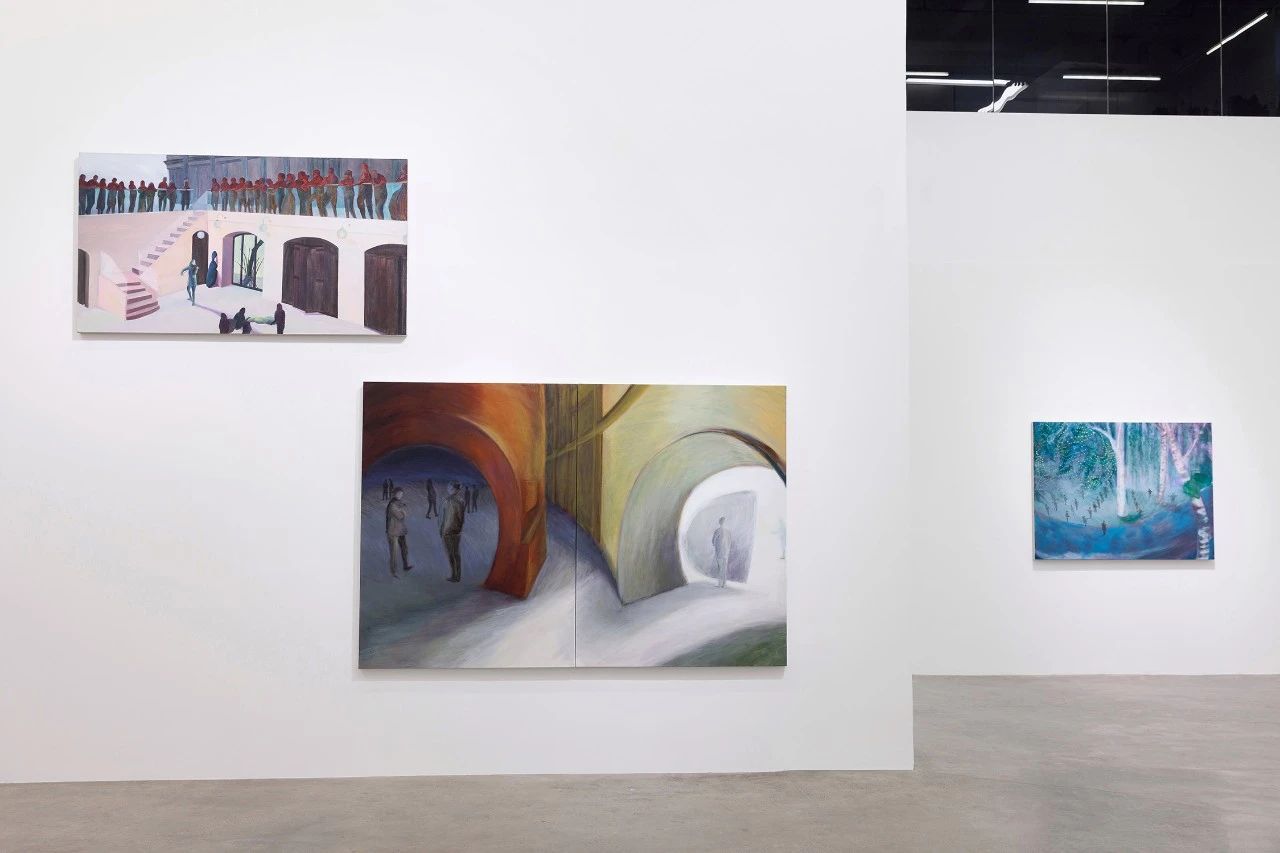

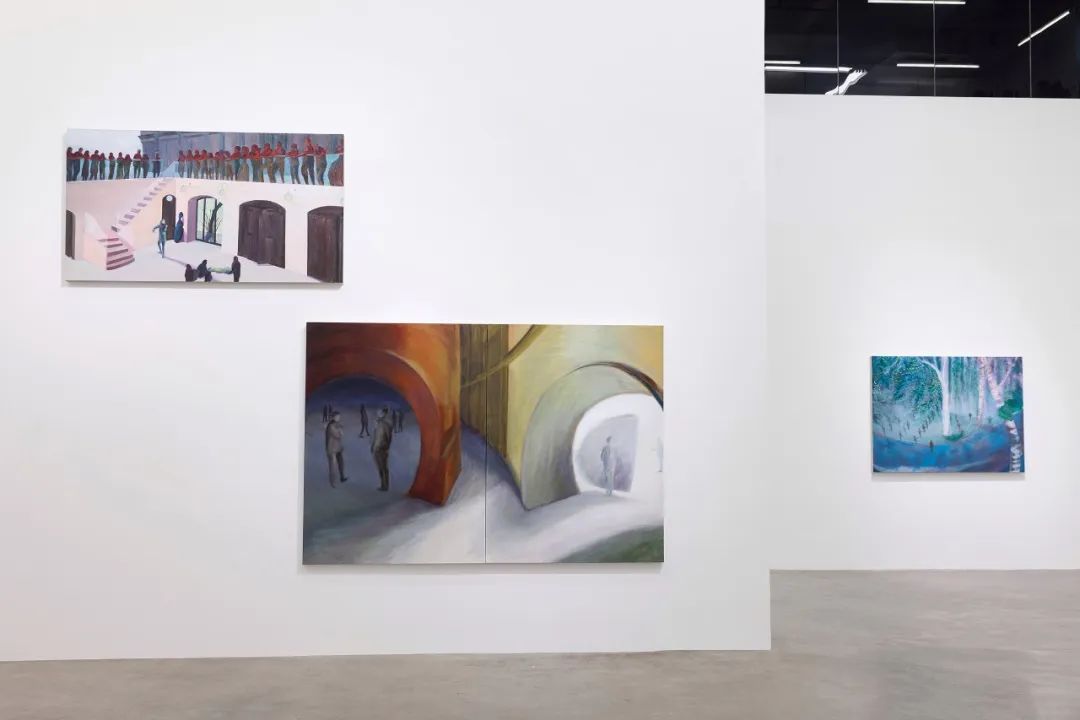
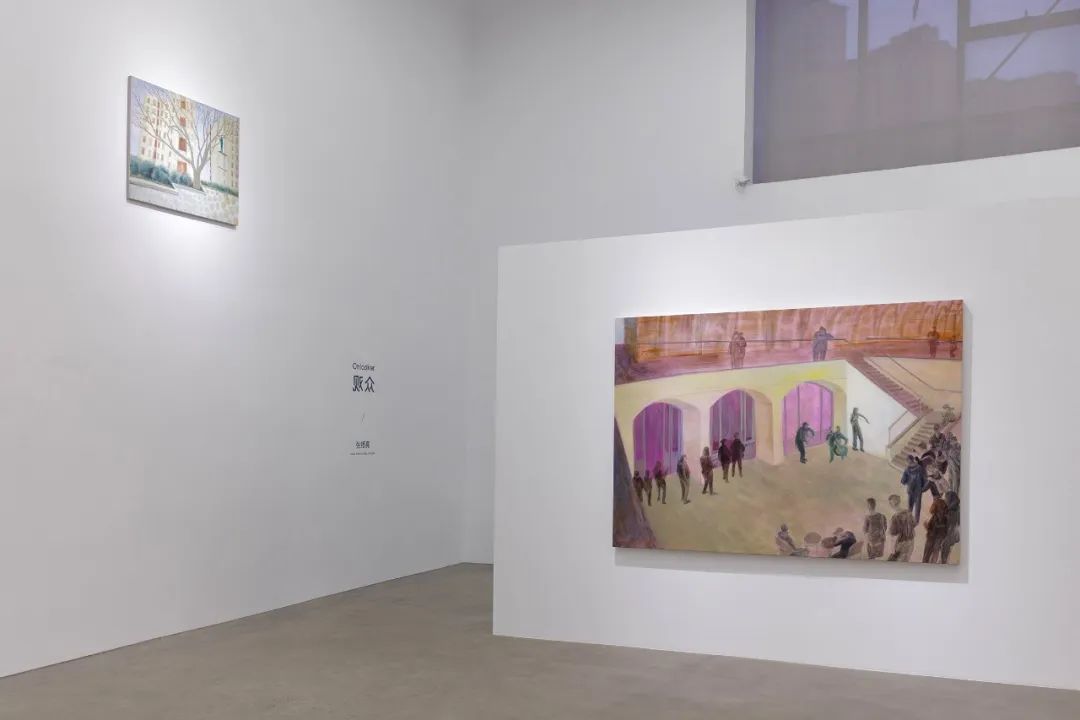
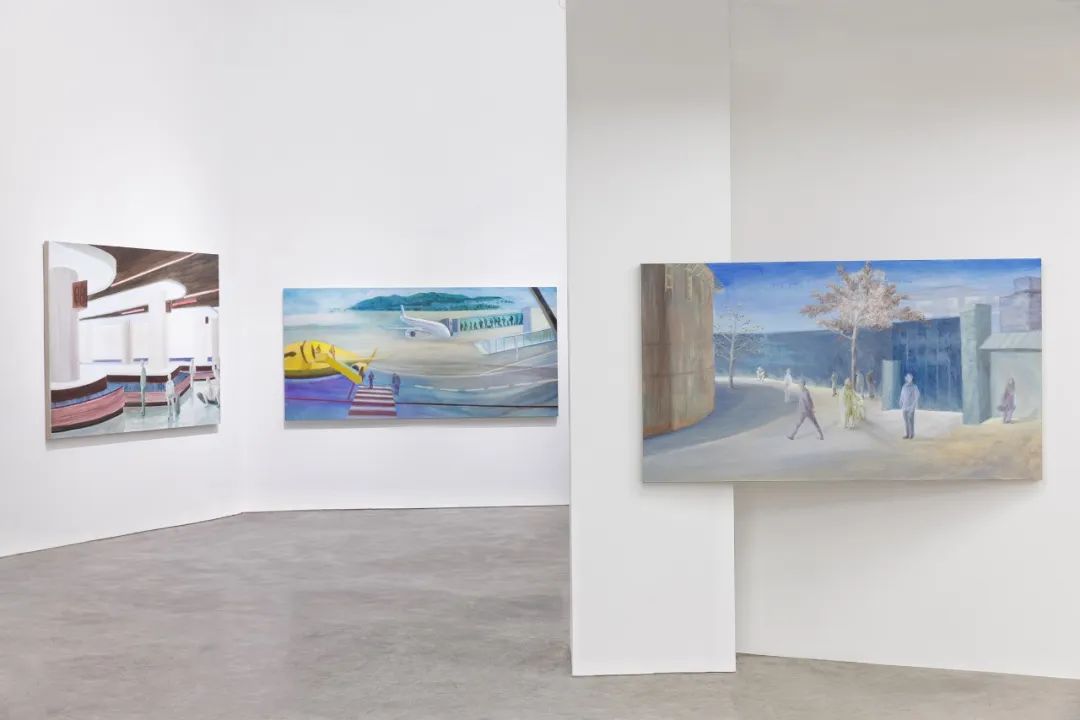
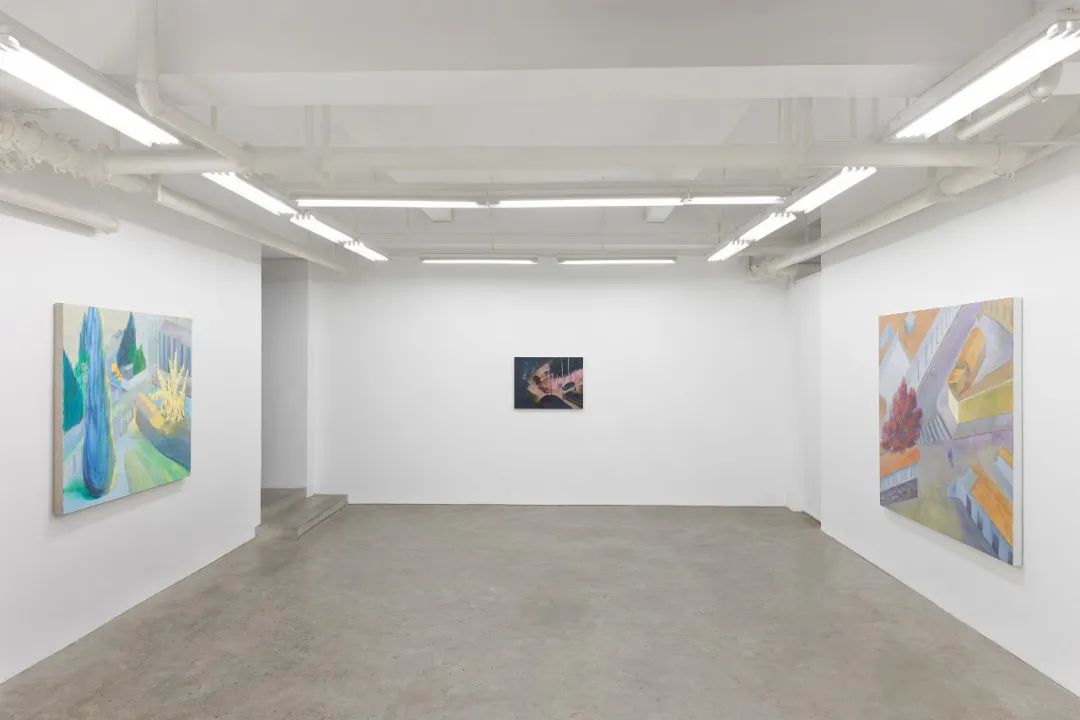
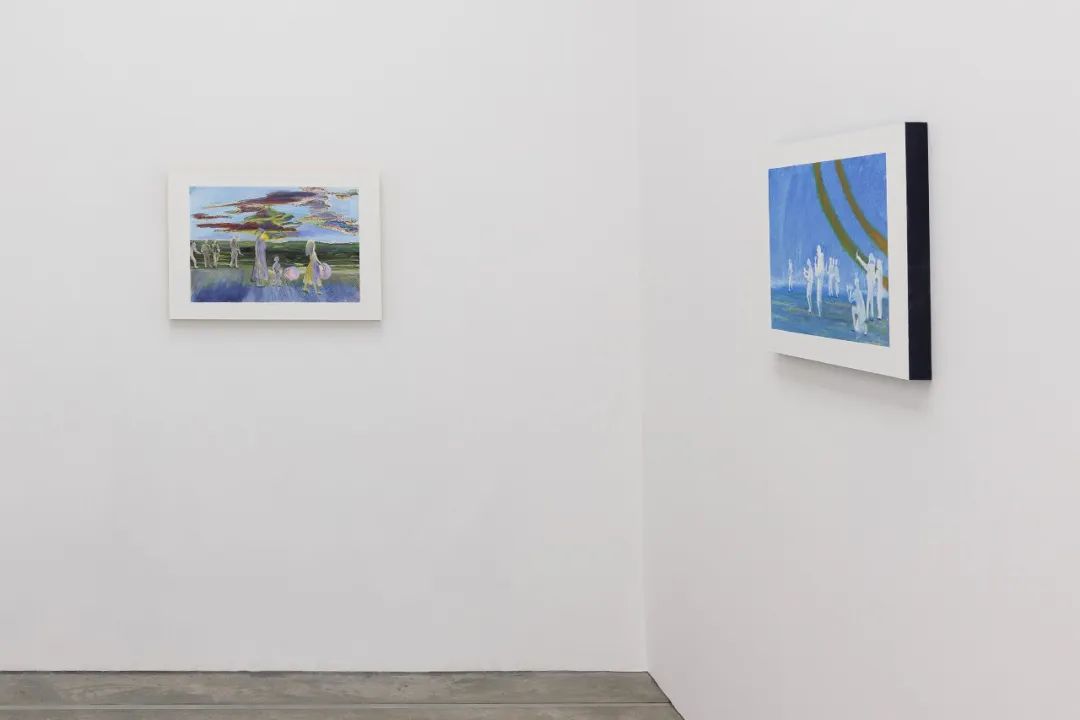
 展览现场
展览现场©艺术家和千高原艺术空间
人们如何观看,又是如何被观看?在张银亮的画面中,观看不是一次性的行为,而是一个由时间、位置与心理状态共同交织出的缓慢展开的过程。展览“观众”包括了六组十余幅布面画作以及数张独幅版画。这些作品聚焦于张银亮视角下世界各地的场景——其中不乏对同一场所跨度近十年的多次描绘,展现了艺术家个体历程和观看的流动。
作为亲历画中现场的边缘看客,艺术家与场景中心保持着疏离的距离。从一个地方到另一个地方,张银亮既是城市的一部分,又始终带着某种外部视角。我们的目光随着她的人生轨迹回溯:泉州、香港、格拉斯哥、伦敦、徐州、北京以及一些短期驻留地。城市们在图像中保持匿名的状态,有时不同地域的视觉经验也以鲜活的色彩拼构成一个场景,例如《停机坪》(2024)画面中两组场景取自不同国家的机场,现实的物理边界由此消融。
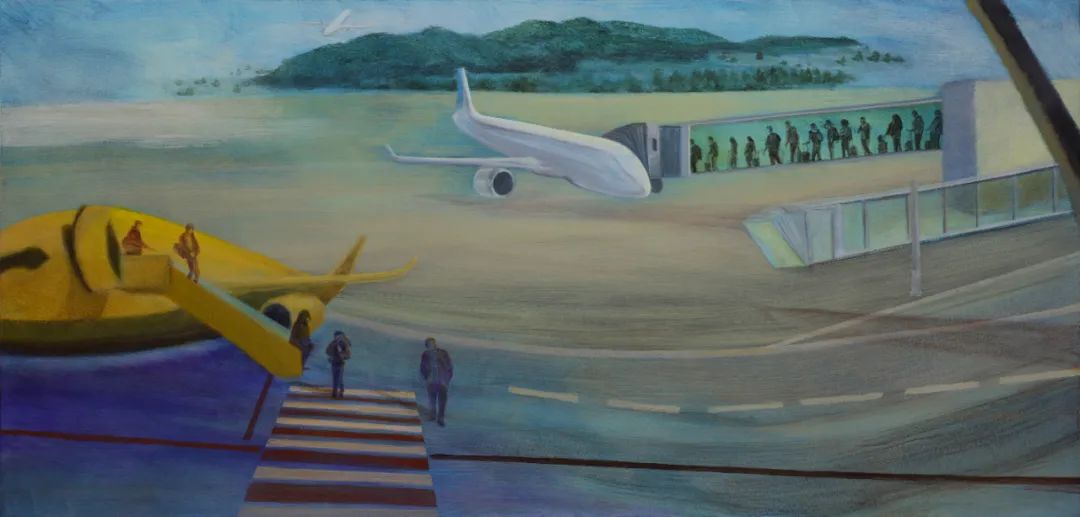
▲张银亮,停机坪,布面丙烯,120 × 250 cm,2024
Anna Ngan Leong Cheung, Apron, Acrylic on linen, 120 × 250 cm, 2024
©艺术家和千高原艺术空间
我不禁想起波德莱尔:他是第一位用诗意书写现代交通工具与城市漫游的人,阿兰·德波顿赞颂波德莱尔写下的“候车室之诗”、“加油站之诗”、以及“机场之诗”。张银亮正是这样的观察者,一位画布上的“漫游者”(flâneur),在图像中重新发现那些看似熟悉却已发生改变的空间,她的作品常常涉及“通道”与“转换”的隐喻。《停机坪》描绘了两架飞机停靠在跑道的情景,画面左侧的旅人正步出悬梯,画面右侧则展现了一组乘客通过廊桥的登机时刻,远方地平线则被稀释进淡化的背景。
艺术家在画面中忽略了一些无关紧要的图示,比如说航司的航徽和舷窗,类似的设定在《机场-CD028》(2023)中也被深化,人物仿佛隐没在以柱状与弧形构成的行李提取大厅中,标识被抹除,空间因而显得更为空灵与抽象。艺术家有意剥离了场所中的识别性符号,以此强调空间本身在结构与几何构成上的“陌生性”。这种陌生化,不是让观众无法识别,而是引导我们进入一种更根本的观看状态:以结构、光线、流线而非意义与功能来理解空间。
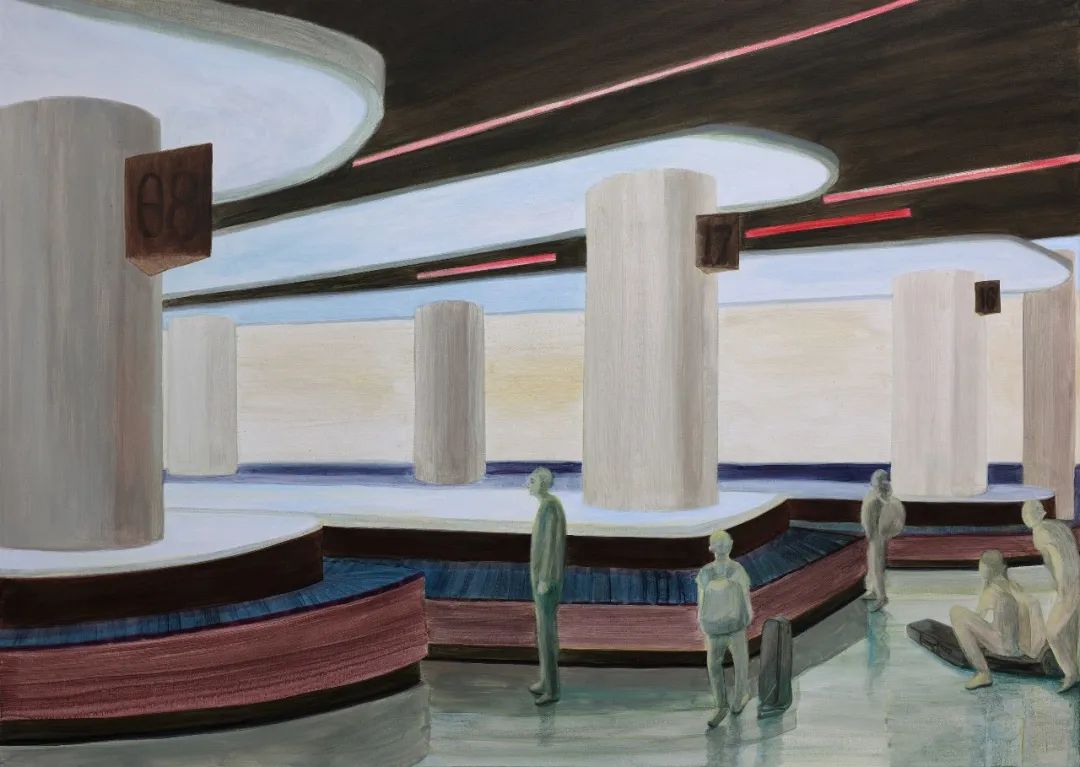
▲张银亮,机场 – CD028,布面丙烯,150 × 210 cm,2023
Anna Ngan Leong Cheung, The Airport – CD028, Acrylic on linen, 150 × 210 cm, 2023
©艺术家和千高原艺术空间
她笔下的空间常常呈现出内外翻转的结构:从《气罐》(2024)与《工业园》(2024)中对同一栋建筑结构内与外的互文描绘,到《机场-CD028》中德勒兹式“光滑空间”与《停机坪》对差别视角的呈现。内部与外部,出发与到达,起始与结束,皆以对照的方式展开,揭示她理解世界的一体两面。
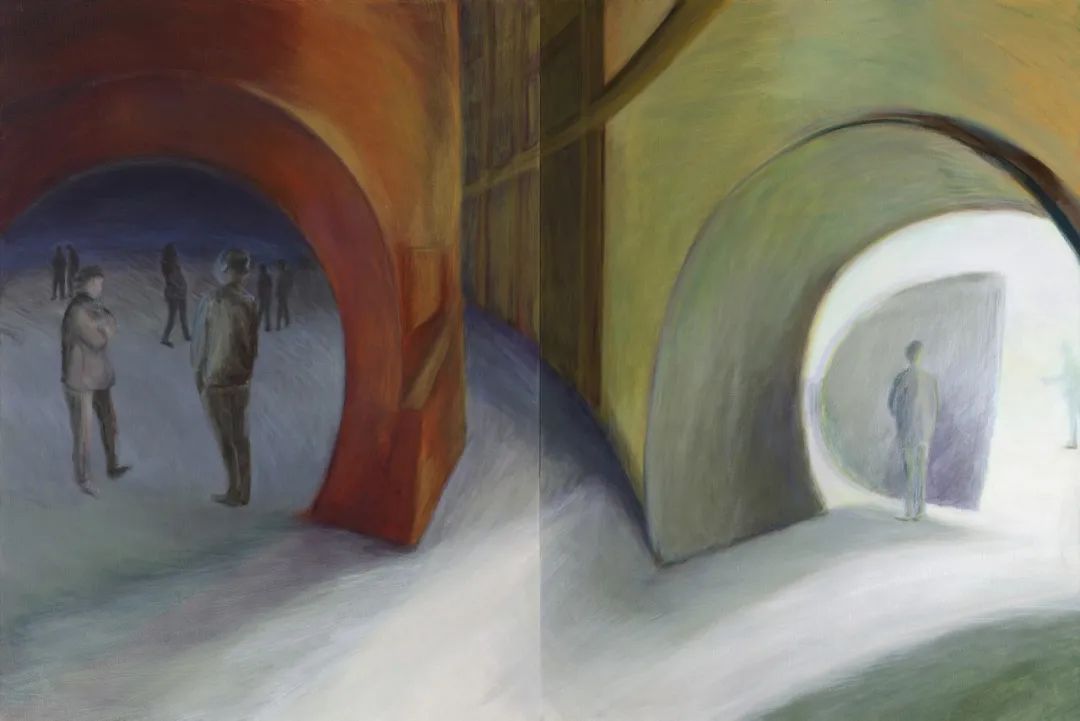
▲张银亮,⽓罐,布面丙烯,160 × 120 cm × 2,2024
Anna Ngan Leong Cheung, Gas Tank, Acrylic on linen, 160 × 120 cm × 2, 2024
©艺术家和千高原艺术空间
“……假设我们走过一条通道,登上飞机,那么数小时之后,我们将置身于一个全然陌生的地方,在那里,没有人知道我们的名字。” 阿兰·德波顿在《旅行的艺术》中如此描绘正在登机的旅人。在与艺术家的交流中,我留意到了她的经历重复并强调了从一个地点到另一个地点的视线跳跃,地点的变换让银亮成为一位细致的观察者,一位“漫游者”式的实践者。这与人类的经验相通——谁不喜欢抄近路呢?比如为了规避拥堵,人们倾向于选择走某些社区的内部道路;或者为尽快抵达下一个目的地,从地铁站的不同出入口穿行——说起来,这类步行路径在香港颇为常见,在那里,艺术家度过了自己的青少年时光。这些场所不是某个明确的地理点,而是由她行经过的生活轨迹构成的。在这点上,她既像是本雅明笔下的“波希米亚漫游者”,在不断游走中捕捉城市片段;也像是蒂姆·英戈尔德所说的“行走线索”(lines of wayfaring),通过移动生成感知。此种游走不只是空间上的,也是心理的——她反复回到某些场景(如考文特花园、旧称彭城的徐州街头)进行再描绘,不断刷新观看的位置。绘画在她这里成为一种时间性的感知练习,也是对记忆的返修。
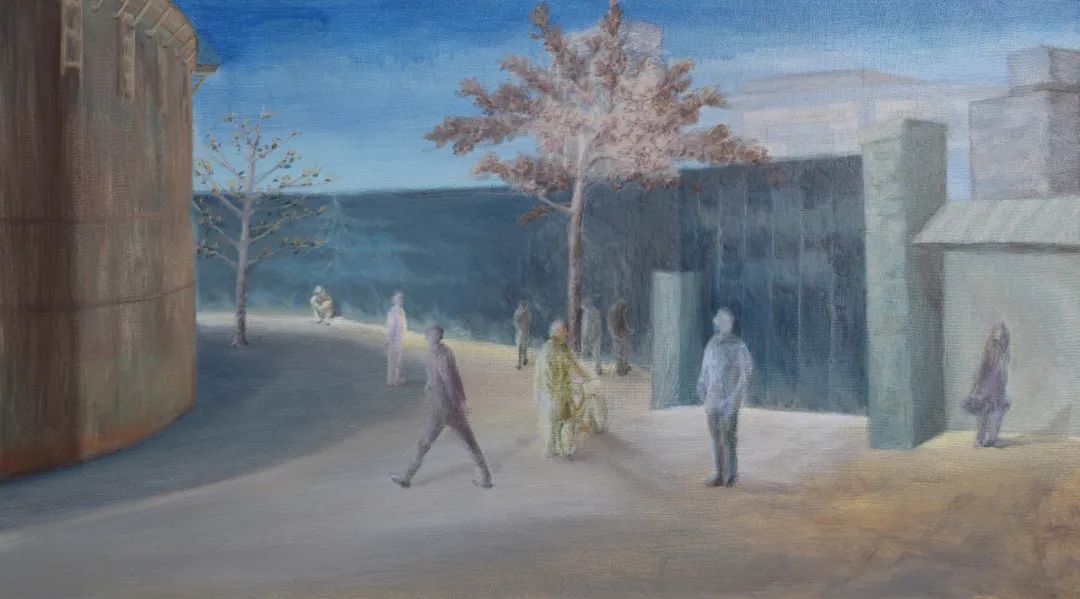
▲张银亮,⼯业园,布面丙烯,100 × 180 cm,2024
Anna Ngan Leong Cheung, Industrial Park, Acrylic on linen, 100 × 180 cm, 2024
©艺术家和千高原艺术空间
张银亮笔下的画面由薄涂的油彩或丙烯层层叠加,这种轻薄的处理使其中的一些物体或人物呈现出半透明的质感,它与艺术家制作独幅版画的经验异质同源:她将快速绘制在金属板上的图像转印到纸张上,之后又在画面上手绘新的色层,形成带有轻微偏移、失焦的画面效果——像是记忆被一次次拖动,又反复堆叠的过程。展览中的两幅版画近作搓揉了版画与架上绘画的画法,它们描绘了人群在观看自然景观时的视觉惯性,不直接刻画光与天色,通过人物的高度抽象化,间接传达出自然的奇观。
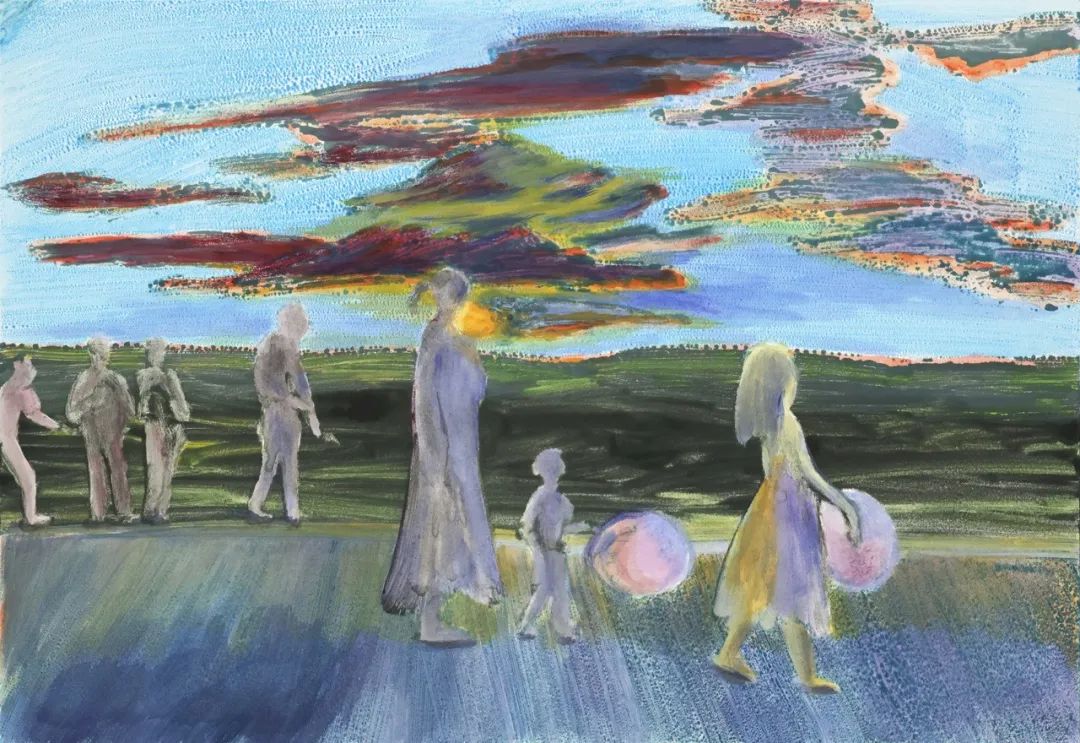
▲张银亮,右边,纸上独幅版画,38 × 56 cm,2025
Anna Ngan Leong Cheung, On The Right, Monotype on archival paper, 38 × 56 cm, 2025
©艺术家和千高原艺术空间
艺术家在一次对话中谈到画面中的“人”,对于她来说,这些“人物”是一个空的空间,成为“介于事件与背景之间”的存在。在跳舞的、行走的、蹲在墙角的人像是街景的附属品,他们是彰显城市规模的刻度,也是透明的即将消散在墙面中的幻影。在画面中,“人”并不是叙事的主角,而更像是运动中的空的空间——是被环境结构所包围,又参与结构形态生成的存在。
18世纪以来,人类的共情能力不再依赖于紧密社群,而源自个体的流动经验。雷蒙德·威廉斯在《乡村与城市》中写道:“一种基本的疏离、沉默和孤独已成为现代人性的载体。”张银亮的绘画继承了这一现代经验。她画作描绘的景物氛围热烈,但画面的情绪却非常克制,让观者代入了艺术家的视角,感受到他们内心的平静和审慎观察。齐美尔在《大都市与精神生活》中曾指出,都市生活造就了个体的“神经质”和“内在防御机制”,人们在高度密集的信息刺激下学会以冷静和距离来保护自我。而在张银亮的画中,我们或许可以看到这种都市经验的另一种回应方式:她不是简单地冷漠抽离,而是在这种防御性的距离中反复进入现场,以一种非中心、非介入、但高度细致的方式去观察、去记录。这种“边缘式观看”既是生存策略,也是一种绘画语言的建构。
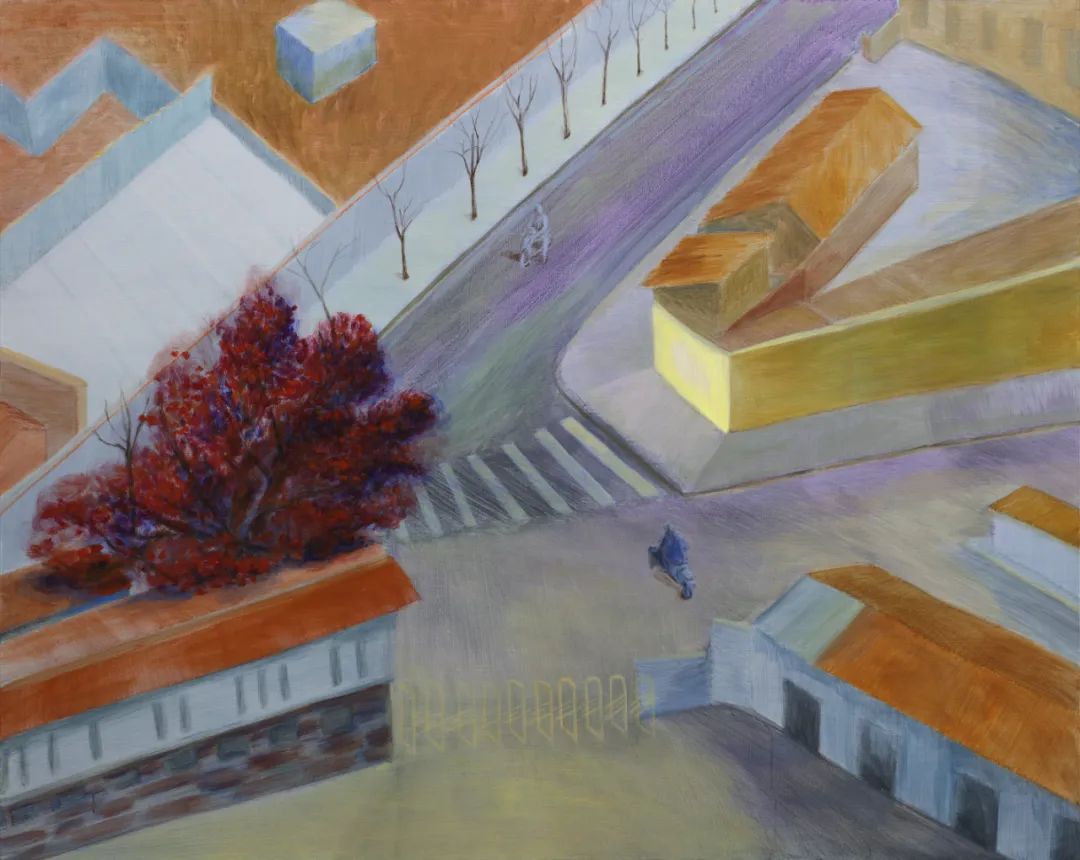
▲张银亮,彭城街⻆ VX,布⾯丙烯,150 × 190 cm,2025
Anna Ngan Leong Cheung, Pengcheng Corner VX, Acrylic on linen, 150 × 190 cm, 2025
©艺术家和千高原艺术空间
无论是《火树银花》(2023)中正在穿戴节庆装饰的独木,还是《路旁装饰》(2024)中占据视觉焦点的圣诞树,比起人物,树在张银亮的描绘对象中,处于更中心的位置。《工业园》中的几棵树木有着不和它们外形对称的影子,产生了某种不容忽略的错位感。对艺术家而言,现实的复杂性是时刻存在的,近几年,突发性事件正在加速进行,一切都无法精准预测。在“彭城街角”系列的几幅作品中,舞动的树木披着明亮的灯光,从住宅楼窗口望下去的生机勃勃的树木渐渐在最近的组画中消失。在艺术家的生活坐标下,以年为时间跨度,这些“街角”图像构成一种缓慢的时间叠影,更替着生命和人为干预之后的磨合局面。
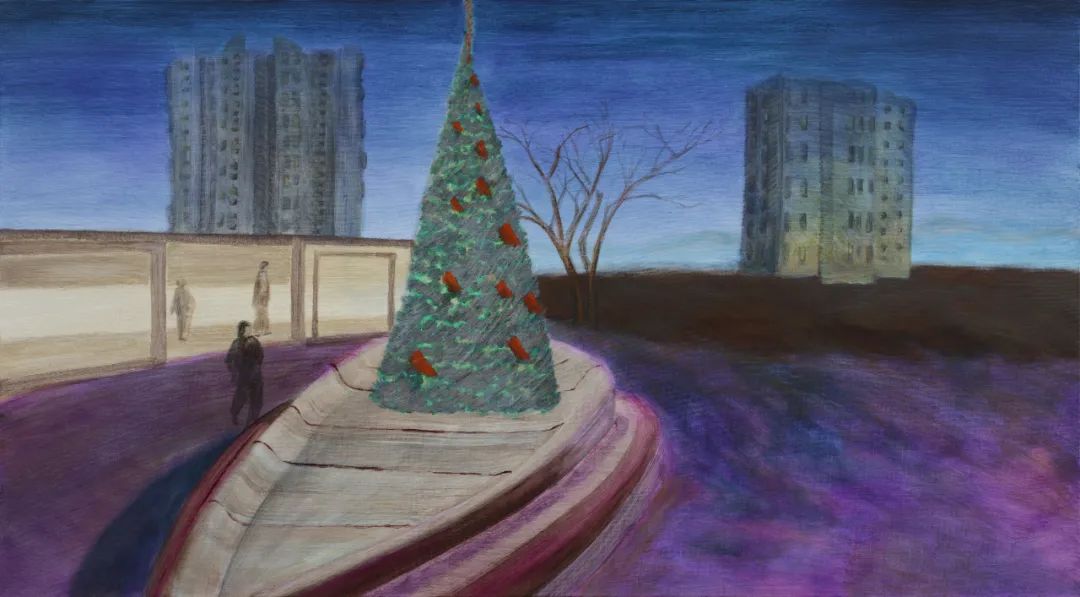
▲张银亮,路旁装饰,布面丙烯,100 × 180 cm,2024
Anna Ngan Leong Cheung, Roadside Decorations, Acrylic on linen, 100 × 180 cm, 2024
©艺术家和千高原艺术空间
展览中几组对城市公共空间的描绘尤为突出。《考文特花园XXI》(2017–2019)与《考文特花园XXII》(2024)跨越七年描绘同一视角。前者画面开阔、氛围凝止,显现出初到伦敦时的审慎与抽离;而后者则更加饱满、细节繁复,体现了她与此地关系的演变。随着时间变幻,艺术家对某地的观看方式也发生着变化——其中有正面的滋养;也有负面的怠倦。她将自己心理和精神状态的转化,以及对环境的理解或质疑表露在画面中。
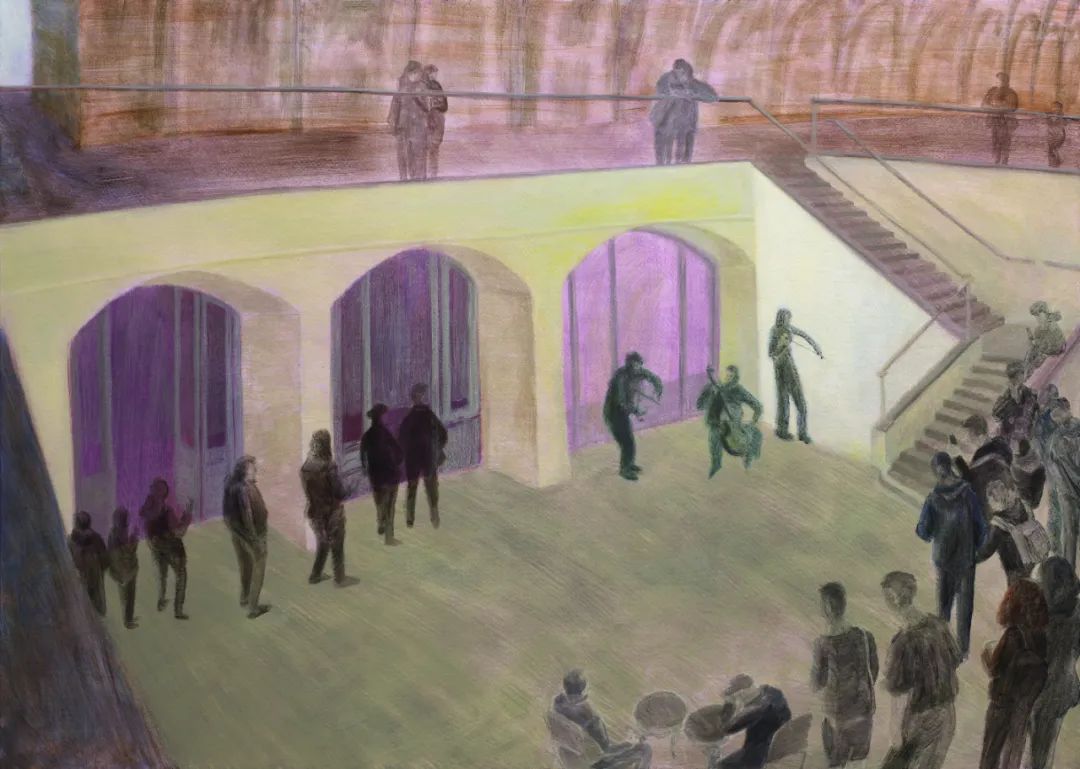
▲张银亮,考⽂特花园 XXII,布面丙烯,150 × 210 cm,2024
Anna Ngan Leong Cheung, Covent Garden XXII, Acrylic on linen, 150 × 210 cm, 2024
©艺术家和千高原艺术空间
段义孚将“地方感”(sense of place)定义为人对空间的情感体验的讨论。也许艺术家风格的观看方式是段义孚式的“地方感”在画面中的延续。空间不再是固定的地理容器,而是由情感经验所建构的动态场域。张银亮的画面正是这一理论的可视化,她用一种审慎、流动的视线重新唤起对空间的感知。在她笔下,异乡成为反身观看的媒介,转瞬即逝的路径转化为日常生活中的隐秘仪式。它提醒着我们观看从未是完整的、客观的,正因人对空间的情感体验不断变化,令观看本身成为一个持续展开的过程。
Anna Ngan Leong Cheung’s
Solo Exhibition: Onlooker
How do people see and how are they being seen? In Cheung's paintings, seeing is not a one-time act, but a slowly unfolding process interwoven with time, location and psychological state. The exhibition ‘Onlooker’ includes six groups of more than ten paintings and several monotypes. These works focus on scenes from around the world from Cheung’s perspectives- many of which depict the same place multiple times over a period of nearly ten years, both the artist's individual journey and the flow of seeing.
As a marginal viewer who personally experiences the scene in the painting, the artist maintains a detached distance from the centre of the scene. Moving from place to place, Cheung is both part of the city and always carries a certain external perspective. Our gaze follows her back through her life: Quanzhou, Hong Kong, Glasgow, London, Xuzhou, Beijing and some short-term residencies. Cities remain anonymous in the imageries, and sometimes the visual experiences of different places are put together in vivid colours to form a scene, for example, the two sets of scenes in Apron (2024) are taken from airports in different countries, and the physical boundaries of reality are thus dissolved.
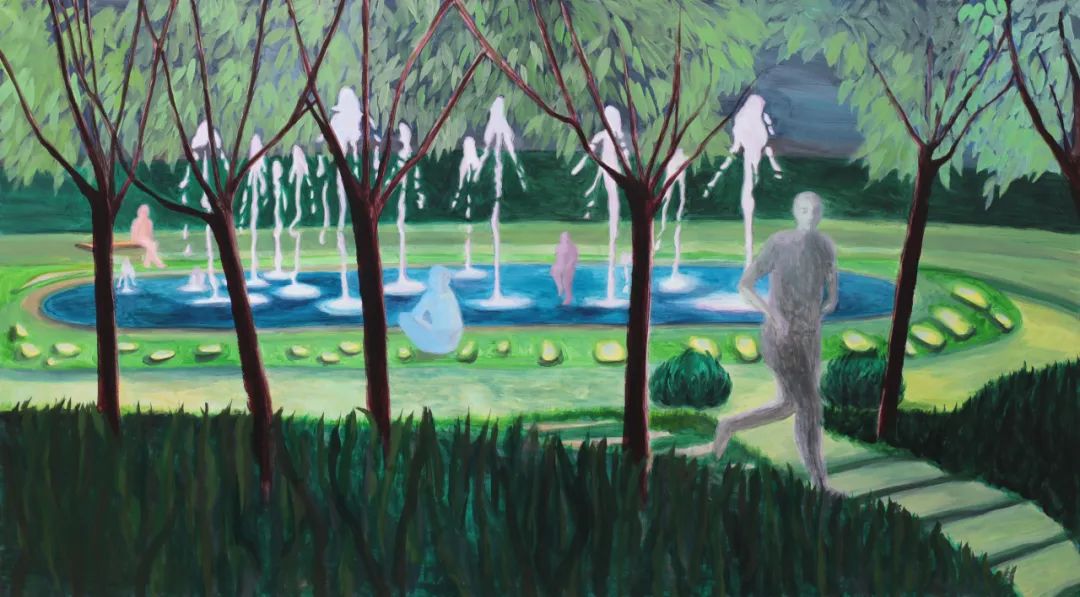
▲张银亮,喷泉,布面丙烯,100 × 180 cm,2022-2023
Anna Ngan Leong Cheung, Fountain, Acrylic on linen, 100 × 180 cm, 2022-2023
©艺术家和千高原艺术空间
I can't help but think of Charles Baudelaire, who was the first to write poetically about modern transport and urban wanderings. Alain de Botton celebrated his ‘Poem of the Waiting Room’, ‘Poem of the Petrol Station’, and ‘Poem of the Airport’. Cheung is a keen observer, a ‘flâneur’ on the canvas. Through her imagery, she rediscovers spaces that seem familiar but have changed. Her works often involve metaphors of ‘passage’ and ‘transformation’. In Apron , two planes are parked on a runway, with travellers stepping out of an overhanging staircase on the left and a group of passengers boarding a flight via a bridge on the right, the distant horizon is diluted into a faded background.
The artist has omitted some irrelevant iconography, such as airline logos and portholes. This concept is deepened in The Airport- CD028 (2023), where the figures seem to be hidden in the baggage claim hall, which is composed of columns and arcs. The logos are erased, making the space seem more ethereal and abstract. The artist has intentionally stripped away the identifying symbols of the place in order to emphasise the ‘strangeness’ of the space itself in terms of its structure and geometric composition. This strangeness is not to make the space unrecognisable to the viewer, but to lead us to a more fundamental state of seeing: to understand the space in terms of structure, light and flow, rather than its significance and function.
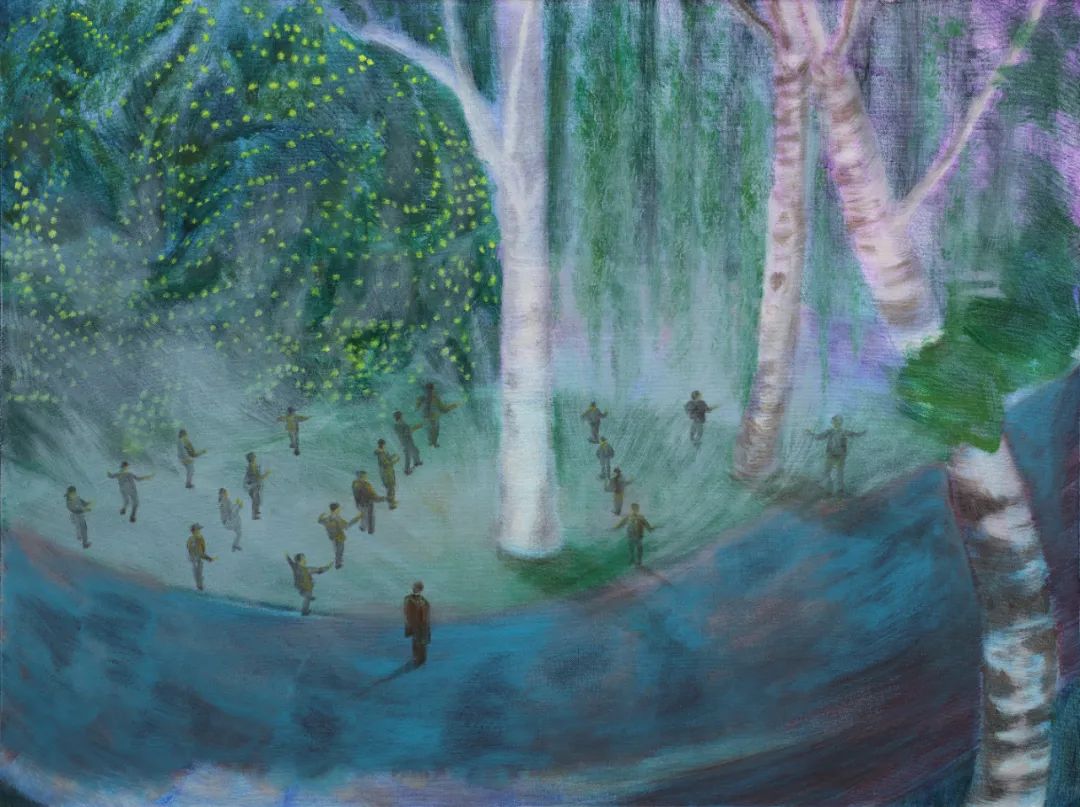
▲张银亮,杨树林,布面丙烯,120 × 160 cm,2025
Anna Ngan Leong Cheung, The Poplars, Acrylic on linen, 120 × 160 cm, 2025
©艺术家和千高原艺术空间
The spaces she painted often present a structure that flips inside and outside: from the intertextual depiction of inside and outside of the same building structure in Gas Tank (2024) and Industrial Park (2024), to the presentation of different perspectives between the Deleuzian ‘smooth space’ in The Airport- CD028 and Apron. The contrast between inside and outside, departure and arrival, and beginning and the end, all unfold in a way that reveals the two sides of her worldview.
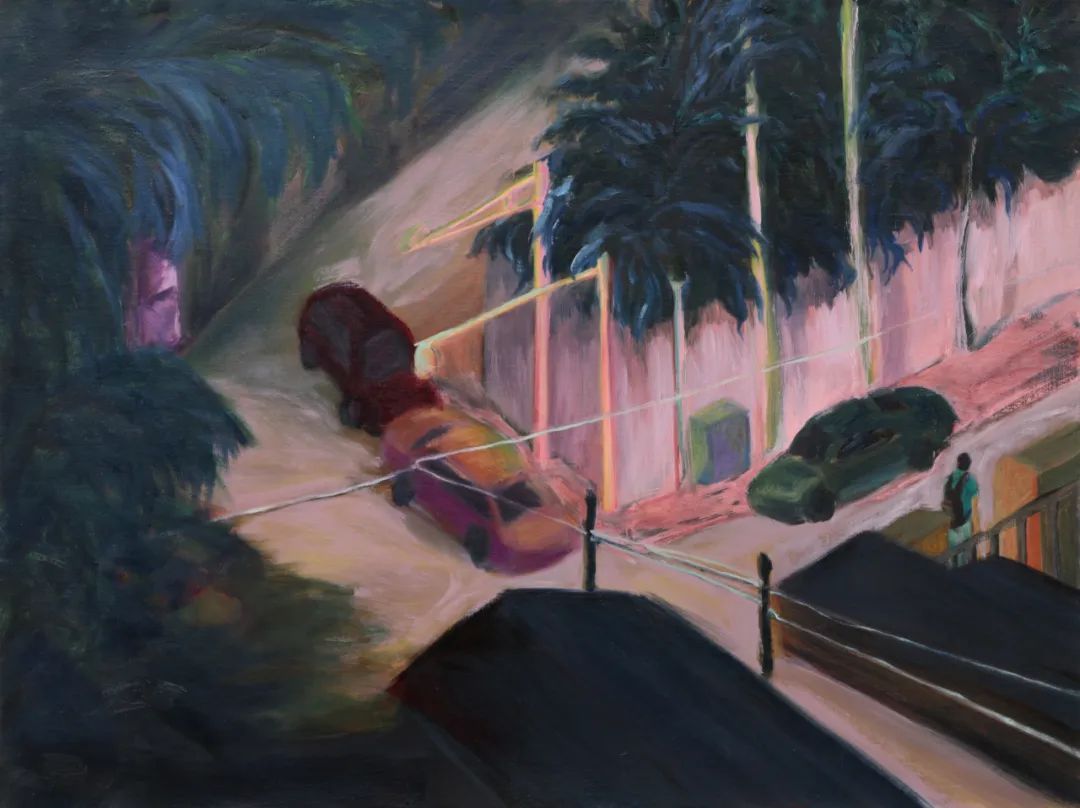
▲张银亮,彭城街角 III,布面油画,100 × 180 cm,2024
Anna Ngan Leong Cheung, Pengcheng Corner III, Oil on linen, 100 × 180 cm, 2024
©艺术家和千高原艺术空间
“…were we to walk sown a corridor and on to a craft that in a few hours would land us in a place of which we had no memories and there no one knew our names.” This is how Alain de Botton describes travellers boarding a plane in The Art of Travel. In my interactions with the artist, I have noticed her emphasis on moving from one place to another. The shifting of locations that makes Cheung a meticulous observer, a practitioner of the ‘wanderer’ style. This is similar to the human experience – who doesn't like to take shortcuts? People tend to take the internal roads of certain neighbourhoods to avoid congestion, or walk through the different entrances and exits of MTR stations in order to get to their next destination as quickly as possible. This type of walking path is quite common in Hong Kong, where the artist spent her teenage years. These sites are not geographically defined points, but rather the trajectories of the lives she has travelled through. In this respect, she is at once Benjamin's ‘Bohemian Flâneur’, capturing fragments of the city as she moves about, and Tim Ingold's ‘lines of wayfaring’, generating perceptions through movement. This wandering is not only spatial, but also psychological: she repeatedly returns to certain scenes (e.g. Covent Garden and the streets of Xuzhou, formerly Pengcheng) to redraw them, constantly refreshing the observer's perspective. Painting in her case becomes a temporal, perceptual exercise and a return to memory.
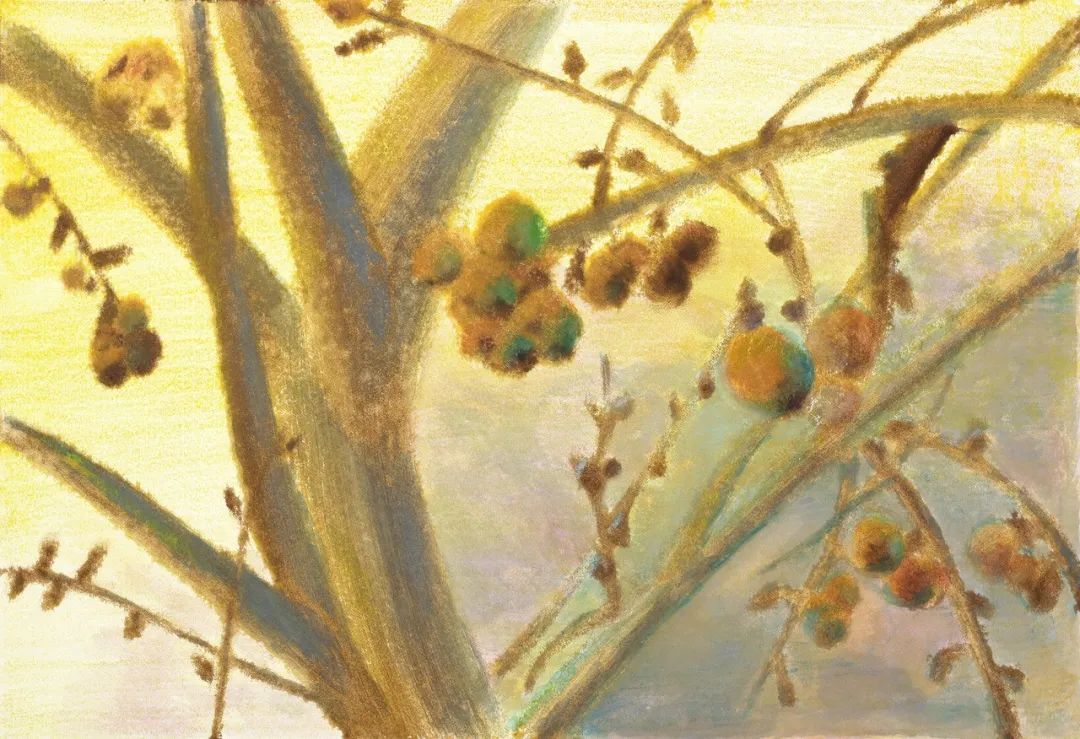
▲张银亮,往上,纸上独幅版画,38 × 56 cm,2025
Anna Ngan Leong Cheung, Move Upwards, Monotype on archival paper, 38 × 56 cm, 2025
©艺术家和千高原艺术空间
Cheung's imageries are layered with thin coats of oil or acrylic, a light treatment that gives some of the objects or figures a translucent texture. This process is similar to the artist's method of creating monotypes: she transfers the imagery from a quick drawing on a metal plate to paper, and then hand-paints new layers of colour onto it, creating an effect whereby the imagery is slightly shifted and out of focus. It is like the process of memory being dragged and stacked over and over again. The two recent prints in the exhibition are a rubbing of printmaking and easel painting, depicting the visual inertia of crowds of people looking at landscapes. They indirectly convey the wonders of nature through the highly abstract figures rather than directly depicting the light and colour of the sky.
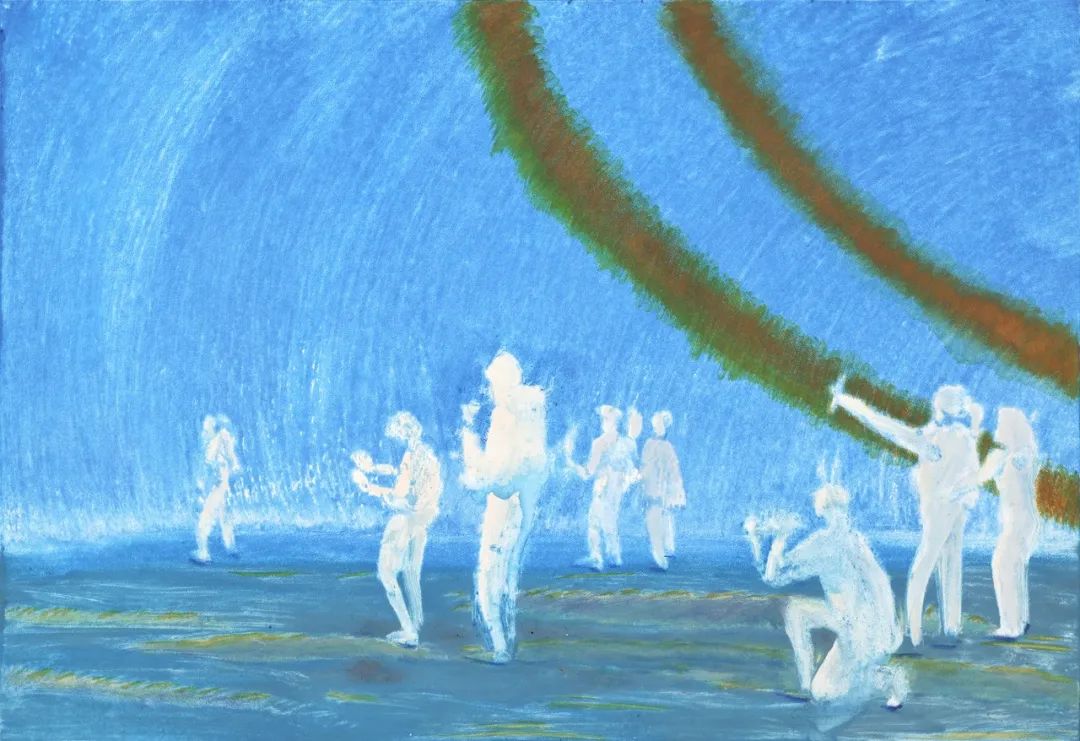
▲张银亮,左边,纸上独幅版画,38 × 56 cm,2025
Anna Ngan Leong Cheung, On The Left, Monotype on archival paper, 38 × 56 cm, 2025
©艺术家和千高原艺术空间
In a dialogue, the artist talked about the ‘people’ in the picture. For her, these ‘figures’ represent empty spaces and exist ‘between the event and the background’. The people dancing, walking and crouching in the corners of the walls are like accessories to the cityscape. They are the scale of the city, and transparent phantoms that will soon dissipate into the walls. In the paintings, ‘people’ are not the main characters of the narrative, but more like empty space in motion – an existence surrounded by the structure of their environment and participating in the generation of the structure's form.
Since the 18th century, the human capacity for empathy has not relied on close-knit communities, but has stemmed from the fluid experience of the individual. As Raymond Williams wrote in The Country and the City, “…an essential isolation and silence and loneliness become the carriers of nature and community against the rigours, the cold abstinence, the selfish ease of ordinary society". Cheung's paintings inherit this modern experience. Although the scenes depicted have a heated atmosphere, the mood of the imagery is so restrained that viewers are vicariously transported to the artist's perspective, experiencing their inner calm and prudent observation. As Georg Simmel pointed out in The Metropolis and Mental Life, urban life creates a sense of "nervous intensity" and "protective organ" in individuals, who learn to protect themselves with calmness and distance in response to highly intensive stimulation. In Cheung's paintings, however, we see an alternative response to this urban experience. Rather than simply withdrawing indifferently, she repeatedly enters the scene from this defensive distance, observing and recording in a non-central, non-involved but highly detailed way. This kind of 'marginal viewing' is both a survival strategy and a construction of painting language.
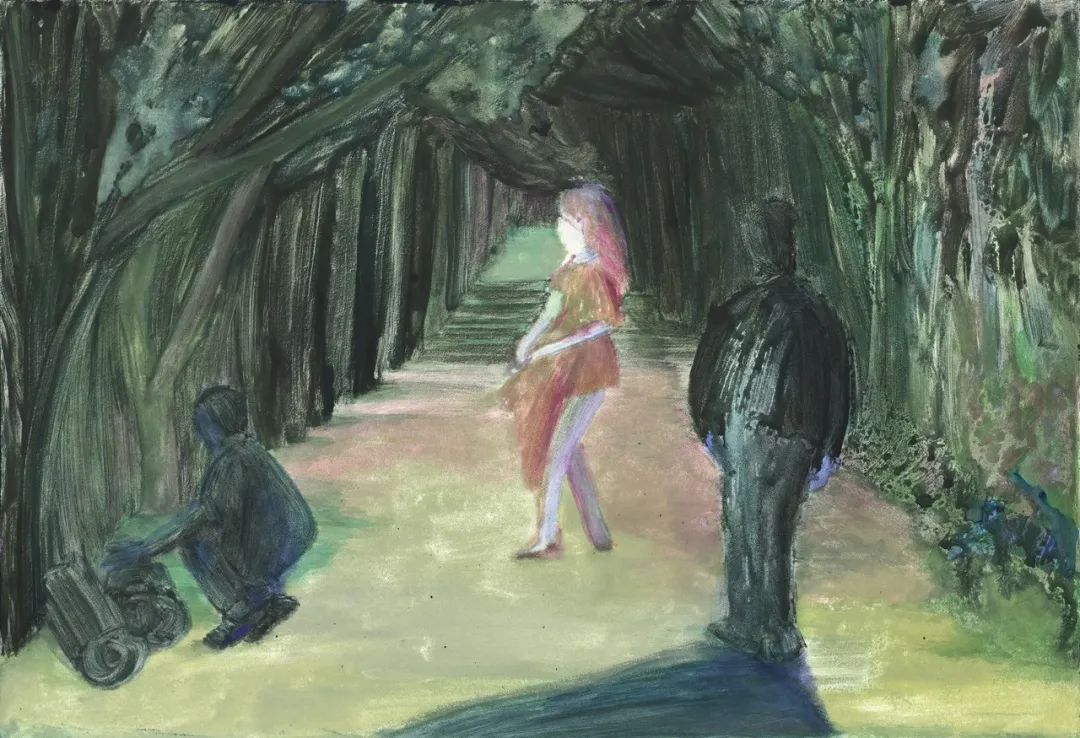
▲张银亮,往里,纸上独幅版画,38 × 56 cm,2025
Anna Ngan Leong Cheung, Move Inwards, Monotype on archival paper, 38 × 56 cm, 2025
©艺术家和千高原艺术空间
Whether it's a tree wearing festive decorations in Sparkling Tree (2023) or the Christmas tree occupying the visual focus in Roadside Decorations (2024), trees—rather than human figures—hold a more central position in Cheung's compositions. The trees in Industrial Park have shadows that are not symmetrical to their shapes, creating a certain sense of dislocation that cannot be ignored. For the artist, the complexity of reality is ever-present, and sudden events have been accelerating in recent years, making it impossible to predict anything with precision. In several of the 'Pengcheng Corner' series, dancing trees draped in bright lights can be seen, and the vibrant trees looking down from the windows of residential buildings gradually disappear in the recent series paintings. Over the course of years, these imageries of 'street corners' form a kind of slow, superimposed shadow of time, replacing the situation of life and the friction caused by human intervention.
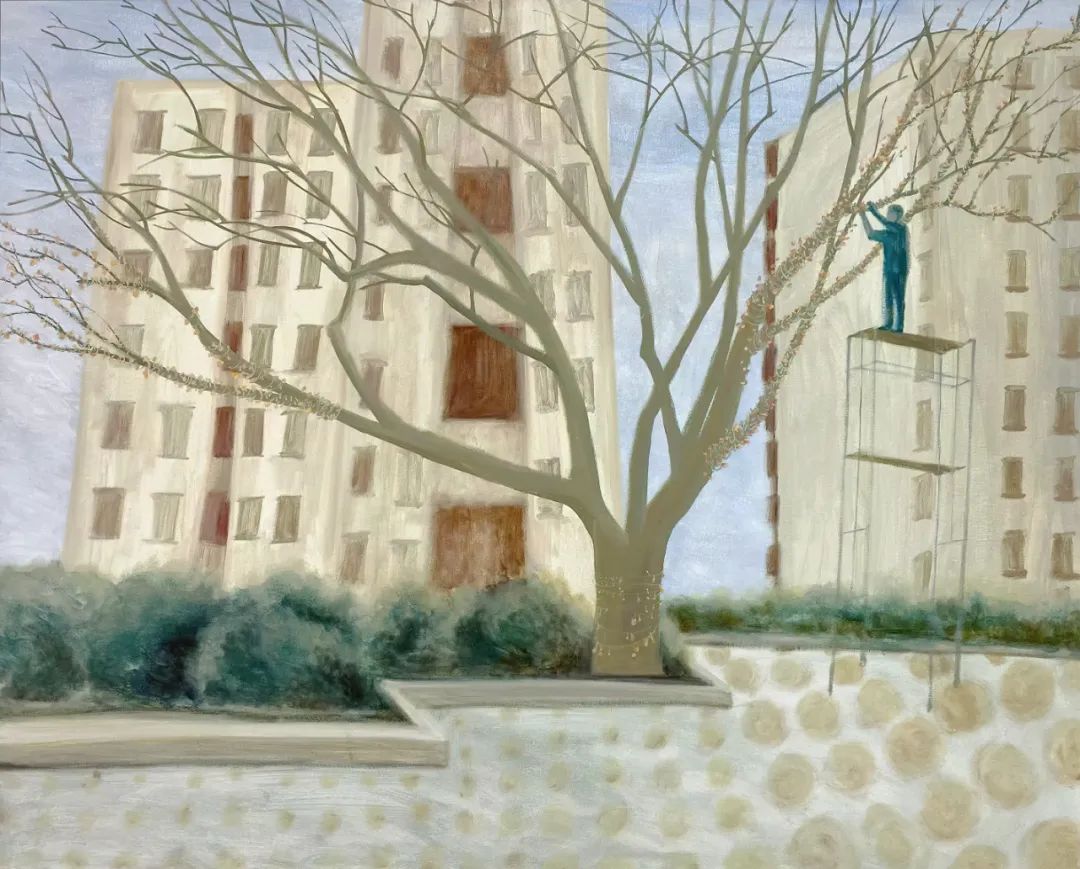
▲张银亮,火树银花,布面油画,80 × 100 cm,2023
Anna Ngan Leong Cheung, Sparkling Tree, Oil on linen, 80 × 100 cm, 2023
©艺术家和千高原艺术空间
Several groups of depictions of urban public spaces stand out in the exhibition. The Covent Garden XXI (2017–2019) and Covent Garden XXII (2024) show the same view taken seven years apart. The former, with its open, stagnant atmosphere, reveals the prudence and abstraction of her first arrival in London, while the latter, with its fuller, more elaborate detail, reflects the evolution of her relationship with the place. As time passes, the artist's perception of a place changes — positive nourishment coexists with negative idleness. Through her imageries, she reveals the transformation of her psychological and mental state, as well as her evolving understanding of, or questions about, her environment.
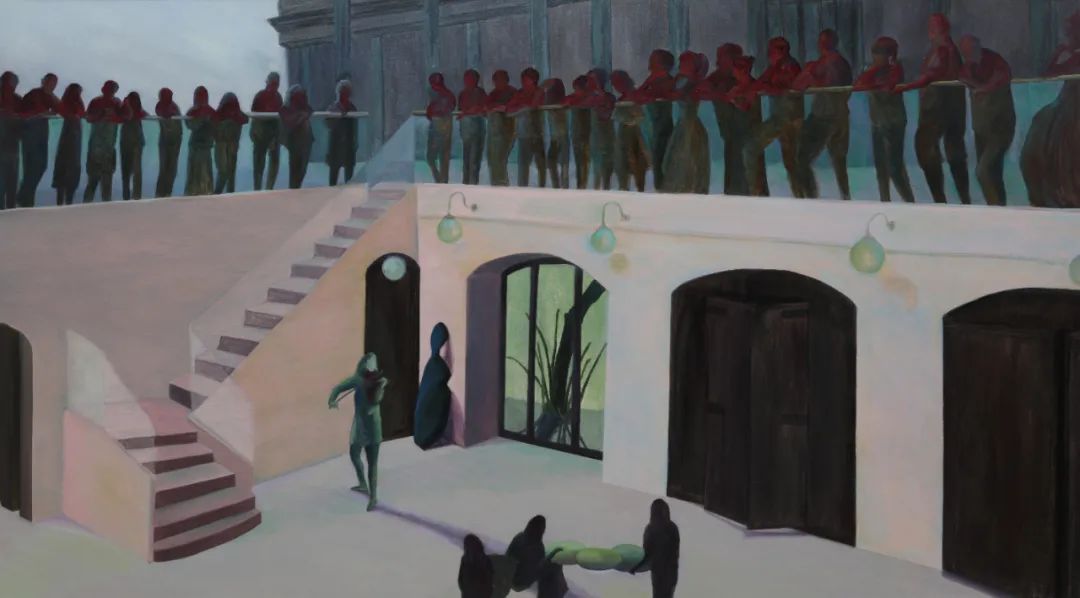
▲张银亮,考⽂特花园 XXI,布面油画,100 × 180 cm,2017-0219
Anna Ngan Leong Cheung, Covent Garden XXI, Oil on linen, 100 × 180 cm, 2017-2019
©艺术家和千高原艺术空间
Yi-fu Tuan defines 'sense of place' as an emotional experience of space. Perhaps the artist's approach to seeing is an extension of this concept in her imagery. In this interpretation, space is not a fixed geographical container, but rather a dynamic field constructed by emotional experience. Cheung's imagery is a visualisation of this theory, and she employs a prudent and fluid approach to reawaken our perception of space. In her paintings, foreign lands become a medium for reflective seeing and transient paths are transformed into hidden rituals of daily life. This reminds us that seeing is never complete or objective; and that it is precisely because one's emotional experience of space is constantly changing, seeing itself becomes a continuously unfolding process.
Text / Sun Wenjie
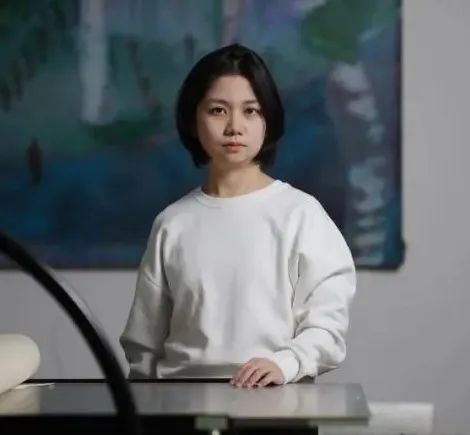
张银亮
Anna Ngan Leong Cheung
张银亮1988年⽣于泉州,现⽣活及⼯作于北京。她毕业于英国格拉斯哥美术学院绘画与版画系,在2015年获英国伦敦⼤学学院斯莱德艺术学院硕⼠学位。
张银亮的作品涵盖绘画、版画及摄影。迁居与变动中的⽣活场景,时常是她的绘画主题,这些地⽅既有具体指向,同时也有发散性的界外视⾓。她的创作探讨⼼理空间的延展性,在绘画中融⼊具⾝经验,从⽽揭⽰⽇常⽣活景象背后的时空变动与内心情感。
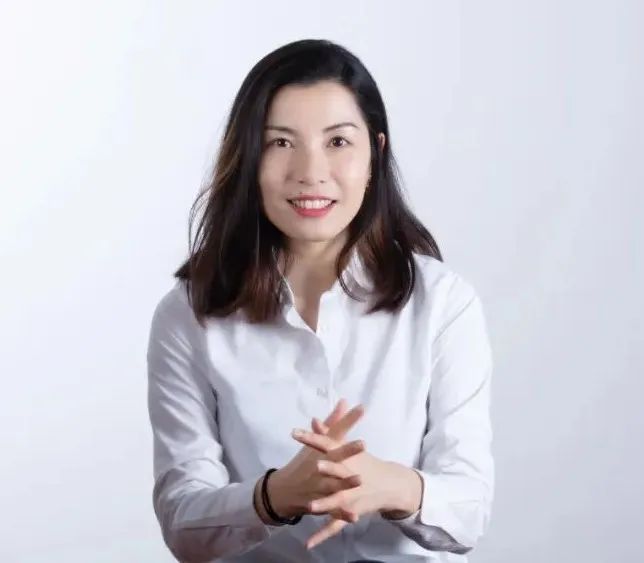
孙文杰
Sun Wenjie
孙文杰是一位策展人。她拥有中央美术学院艺术管理学士学位和伦敦大学金史密斯学院策展艺术硕士学位。孙文杰是2023年度 IVLP(国际访问者领导计划)的参与者。她曾任职红砖美术馆,在担任展览部部长期间,她负责涉及展览、出版物及收藏的项目。
孙文杰是2020年第二届曼谷艺术双年展“逃生路线”的策展人之一。她曾为艺术奖项、基金会、美术馆、画廊、艺博会等机构策划展览项目。在推动红砖美术馆的学术出版之余,她参与了《1945 年以来的当代艺术指南》(2021)的翻译出版,并为克里斯蒂安·扬科夫斯基(Christian Jankowski)等艺术家的画册和其他艺术刊物撰稿。
千高原艺术空间2007年创立于中国成都,是致力于展示并推进中国当代艺术的专业性画廊,设有艺术作品展示厅,影像资料收藏和放映室。主要研究、展示和推动与中国当代艺术文化相关的优秀作品和实验性主体项目,积极开展国内、国际的合作项目。
千高原艺术空间主要展示和推出成长中的有突出才能和价值的艺术家的作品和项目,并发现和推动新的有创造力的艺术家,迄今主要代理和合作的老中青三代艺术家超过30位。通过展览、博览会、学术讨论活动、出版等方式,致力于构架艺术家和社会、机构、收藏者之间的沟通渠道,提供包括艺术作品销售、量身定做的艺术项目、收藏品咨询管理、艺术教育项目以及展览策划。
除了在超过1000平方米的画廊空间的展览项目,千高原艺术空间亦积极参加国际国内的重要艺术博览会,包括香港巴塞尔艺术展(Art Basel HK)、香港国际艺术展(ART HK)、艺术登陆新加坡(Art Stage Singapore)、今日亚洲 | 巴黎亚洲艺术博览会(Asia Now | Paris Asian Art Fair)、上海廿一当代艺术博览会(ART021)、上海西岸艺术与设计博览会(West Bund Art & Design)、艺览北京JING ART、北京当代艺术博览会、艺术成都Art Chengdu、上海艺术影像展(Photo fairs Shanghai)、Paris Photo、西班牙路普艺术节(Festival LOOP Barcelona)、Paris Internationale、LISTE in Basel、ACK(Art Collaboration Kyoto)、Basel Social Club 等等。
A Thousand Plateaus Art Space was founded in 2007 in Chengdu, China. It is a professional gallery committing to presenting and promoting China’s contemporary art. Equipped with exhibition halls for artworks and collections and a screening room for videos and discussions, it focuses on researching, presenting and promoting outstanding works and experimental projects of China’s contemporary art and culture by carrying out domestic and international projects.
A Thousand Plateaus Art Space devotes itself to presenting works by emerging artists who have outstanding talent and merit, and to discovering and promoting new creative artists. To date, it has represented and cooperated with over 30 artists of all ages. Using exhibitions, art fairs, academic discussions, publications and so forth, it is dedicated to establishing the communication channels between artists and the society, institutions and collectors. The gallery also organizes artwork sales, tailored art projects, collection management consultings, art education projects and curatings.
In addition to the exhibitions and events in the over 1,000 square meter gallery space, A Thousand Plateaus Art Space also takes an active part in important international art fairs including Art Basel Hong Kong, Art Hong Kong, Art Stage Singapore, Asia Now | Paris Asian Art Fair, ART021, West Bund Art & Design, JING ART, Beijing Dangdai Art Fair, Art Chengdu, Photo fairs Shanghai, Paris Photo, Festival LOOP Barcelona, Paris Internationale, LISTE Art Fair Basel, ACK(Art Collaboration Kyoto), Basel Social Club etc..
©文章版权归属原创作者,如有侵权请后台联系删除