……推开门,展厅中与你视线最先相接的,是纱幕。它们从一人高的地方分别悬垂下来,将开阔的空间划分出次第。然后才是纱幕背后若隐若现的一切,你向那里走去,像是被自己的视线牵动了身体。在一个被如此命名的,关于记忆和童年的场景中,洁白和轻盈的纱幕即使并不飘动,也能依稀透出仿佛来自夏日傍晚的气息,那些晾在家家户户门口或窗前的被单、衣物,吸收了白天的暑热,成为逐渐深沉的夜色中最后暗下去的部分。尤其是当眼前这些纱幕被一排排竹制夹子整齐地固定在类似晾衣绳的钢丝上,让它们更接近日常的物事及其使用情境。
然而艺术家在这里的用心并不止于此:半透明的纱幕将那些有待被凝神细读的“作品”掩于其后,为了让眼睛看清,身体必须先从这道菲薄的边界穿过。这样的设置与其说是遮挡,莫如说是将游移散漫的视线重新聚拢在一起。对纱幕而言,遮挡亦是袒露甚至强调,造就区隔的同时则引发了对边界的穿越。它们以几乎没有重量的存在重新设定了观看的路径,并使之不断变动、迂回和分岔。
类似的帘幕不止一次出现在栾雪雁的展览现场。三年前在同一处展厅,帘幕化身为工地上随处可见的,绿色和蓝色的防尘网,从角落斜斜拉出或沿墙壁包绕,将墙上排列的画幅部分掩映于其后。这些不算平整、甚至看似“随意”垂落的防尘网,以及支撑和固定它们的尼龙绳与砖块,同墙上讲究的画作一起组成了名为《小风景》的系列。其视觉蓝本源自艺术家在各处城中村的写生,防尘网的颜色与形态——作为中国民间社会的日常视觉样本——经过改头换面,亦时不时地闪现于白墙上整饬排布的画作之中。然而根据艺术家的表述,它们绝不仅是用于制造“沉浸式”效果的某种布景,亦非单独成立的装置作品——在其他展览中,栾雪雁也会改变防尘网的颜色、尺寸和悬挂方式,比如在2023年的一次群展中,她将红色和绿色的防尘网从展厅高达12米的天花板垂挂下来,将画作完全遮挡在纱网后面,观众若要“看清”画作则必须从侧旁穿入纱网和墙壁之间的空隙。
作为功能与形式的一体两面,帘幕既非纯粹的观赏对象,亦非完全的实用物:它对空间的划分完全是虚拟和心理上的;一面几乎没有重量、厚度和根基的墙,并不能阻止任何越界的动作,相反在某些时候更趋向一种引诱。半透明的帘幕在此启动了一个关于内与外、隐与显、遮蔽与揭露、区分与模糊、背景与前景的游戏,看似对立的双方在这个过程中不断滑动、抵消或交换着位置。考虑到艺术家在中国传统绘画领域的修养,或许不难理解她何以能够屡屡援引这样一种技术以及它所呼应的美学理想。
返回到《逹里尼之夏》这样一个被设定了时空距离的回忆场景中,帘幕的存在又像是一个信号,暗示有什么即将在这个舞台上发生(大幕即将拉开……),只是那个揭晓的时刻被无限地延宕了。这是因为记忆与其最终抵达处之间,亦有一道永恒的,半透明的帘幕横亘。但唯有通过这样的中介物,时间中的事物才得以显示其意义。无论是展厅一角堆起来的沙子,还是挂在墙上的老式衣料,或帘子,隔着朦朦胧胧的白色纱幕,这一切的色泽与形态仿佛柔和、松动了起来,化身为某种介乎于现实和想象之间的存在。
沙子等待着儿童的手来搅动,在物质贫乏的年代这是最好的玩具;看上去像是制服的灰色面料和它覆盖着的,有着女士衬衫领子的乳白色丝绵温柔地交缠在一起,这样一种复杂的情感曾经只能以如此含蓄的方式表达;肉色的雪纺如裙裾般从半空中悬吊的的确良衣领下散开,在它旁边的墙上,一袭老式蕾丝窗纱将肉色窗帘遮在后面,如同乐曲动机重现,于不动声色中低诉欲念。而白色的纱幕本身亦承载了具体的历史信息:它们在场地中央呈放射状分布,对应着大连中山广场的圆形辐射结构。
大连,这座北方城市既是这场记忆戏剧的主角,也是其上演的舞台。从最初俄语音译的“逹里尼”,再到日本接管后重新的命名“大连”,名字的更迭只是它令人眼花缭乱的历史剧目切换进程中最显见的一条线索,艺术家的童年记忆也于此叠印和渗入。纱幕底部有着连续的粉绿色图案,像是一度常见于我国公园和道边的护栏,也像海鸥的翅膀或海浪的轮廓,栾雪雁正是以童年时中山广场的护栏为蓝本,将它的形状直接拓印在纱幕上面。
她对于织物的迷恋是显而易见的,无论是白色的纱幕,还是各种色彩、质地的衣料,又或是她最为熟悉的,绘制工笔画所用的绢。这些最柔软和轻盈的东西仿佛从时间的潮水中浸透,吸收和打捞回那些难以为肉眼所见的残余物,后者或许也曾一经“坚固”和“永恒”,如今却只有借助轻柔低微之物显形。比如艺术家在素绢上精心绘制的旧手套、玩偶和搪瓷茶具,再比如展厅最显眼位置悬挂的画作,呈现了一只被放大至一人多高的,磨损的玩具小鹿,后者是艺术家的童年玩伴。这些承载着艺术家童年回忆的日常物件,亦是大连作为一度辉煌的轻工业城市的历史见证。甚至,就在展览带有怀旧气息的标题中,常见于1970年代抒情文学的命名方式,与1910年代的城市旧称,这样的时空错置,已经暗含了这座城跨越纪元的重重往事与沧桑变迁,所有那些巨大、坚硬、模糊、难以把握和测量的东西,只能隔着这样或那样的帘幕,隐约向我们暗示其轮廓,像是一出已佚失的剧目,仅留下标题供人想象它可能的情节。
在展厅的一侧墙上,并排挂着三张貌似老电影海报的图画,分别以不同的字体样式重复着“逹里尼之夏”的主题,以及一些流行于70、80年代的海浪、海鸥、轮船和建筑的图案,这类图案在大连这座海滨城市尤为常见。这类美术字体(其中写在轮船上的“跃进”还包括了70年代盛行,如今早已不复使用的二次简化汉字)和图案设计,曾在建国后直至80年代末的大众视觉文化中扮演了主要角色,它们广泛应用的场景——如黑板报、油印报刊、请柬、日历等等——均已荡然无存。
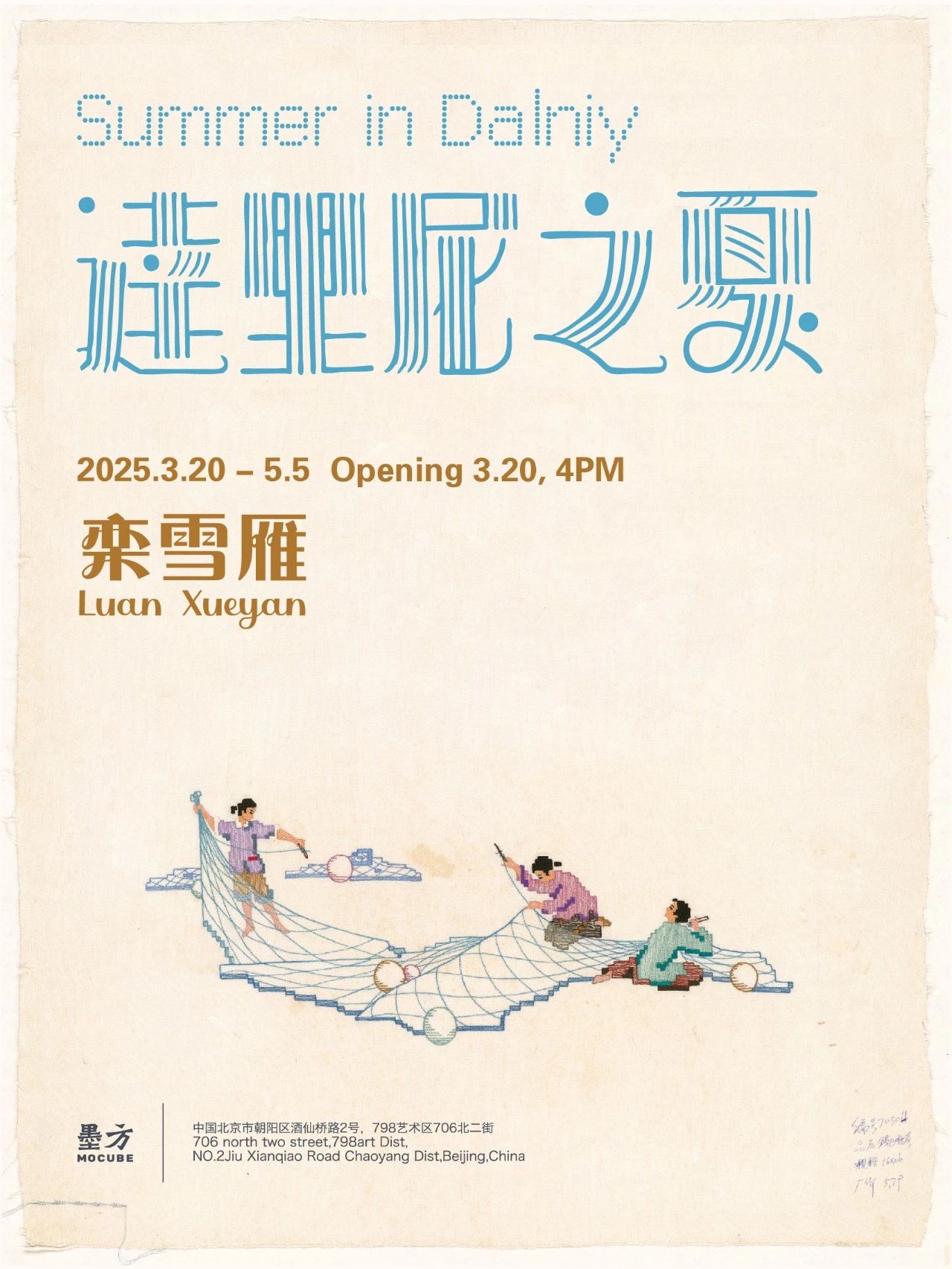
另一侧,展览的入口处,也有一张以美术字体写成的标题。然而这里的每一个字都没有现成的参照物,艺术家根据她对民国字体的研究和理解重新设计和“创造”了这五个字。除了它们显而易见的怀旧风情,这些“美术字”、图案与招贴设计还引出了另一个问题:这些渗透了艺匠心血的“装饰”与“实用”美术,究竟是今天我们所谈的“作品”,还是被使用、消耗和忽视的日常之物?就像展览中的帘幕,我们该如何理解其双重性与不断滑动的意义?
这样的追问从另一个方向再次绕回到历史,或许从一个平凡的家庭故事来追述会让它更加具体:在展厅的二楼,展出了一块机绣绣片打样,这是上世纪六十年代末,艺术家的母亲从国画专业毕业后,刚进入大连工艺美术公司工作时设计的枕套图样。初看上去它似乎并无出奇之处,毕竟对大多数出生在90年代以前的中国人来说,这样的装饰图案在生活中几乎随处可见,无论被单,手绢,还是瓷器……它可以出现在一切日用物品上。然而训练有素的眼睛会迅速捕捉到其中的艺匠经营:虽然是三位渔女在海滩织网的平凡小景,但从景别、构图的裁剪斟酌,到线条、颜色、形状和运动的呼应与对比,再到人物与布景以最凝练的方式传递出的故事性和趣味,抛开其应用的场景,我们几乎无法肯定地说出这究竟是一件“工业设计”,还是真正的艺术创作。
这困惑仅仅是个起点,要清楚地解答这一疑问,或许上万字都不足够。它需要追溯一条甚至许多条交错或分叉的历史线索,而后者恰恰与这座城市从“逹里尼”到“大连”再到今天的百余年历史进程平行。何为“艺术”或“美术”、如何想象艺术与生活的关系、艺术家的位置、个体与集体的价值变迁、人民美术的理想及它对历史前卫精神的延续和错位……所有这些“大”问题都被如此具体地编织在这小小的枕套图案中,从母亲传递给女儿,再传递到另一个时空的另一群观众中间。这仿佛也解释了栾雪雁对于织物的迷恋,以及她对国画传统和技艺的熟稔,然而随同这些一并传递下来的还有这些追问——在展览的两层空间中,那些可以被理解为“创作”的“作品”,同帘幕、画片、布料、装饰图这些来自生活的“物”,被有意不加以区分。同时被混杂起来的,还有日常与历史、瞬时与永恒、记忆与生命……
…Pushing open the door, the first thing that meets your eyes in the exhibition hall is the gauze curtains. Suspended from a height just above a person, they divide the open space into layered sections. Behind them, everything appears faintly visible, and as you walk toward it, it feels as though your gaze is pulling your body along. In a scene so named—one about memory and childhood—the white, ethereal gauze curtains, even when motionless, seem to emanate the aura of a summer evening: the sheets and clothes hung outside every household’s door or window, having absorbed the day’s heat, become the last parts to fade into the deepening night. This impression is heightened by the fact that these curtains are neatly fastened to steel wires resembling clotheslines with rows of bamboo clothespins, bringing them closer to the realm of everyday objects and their contexts of use.
Yet the artist’s intention here goes beyond this: the translucent curtains veil the "works" that demand closer scrutiny, requiring the viewer’s body to first cross this thin boundary before the eyes can see clearly. This arrangement is less an obstruction and more a way to gather scattered, wandering attention. For the gauze curtains, obscuring is also revealing—even emphasizing—creating division while simultaneously inviting transgression. With their almost weightless presence, they redefine the path of viewing, making it fluid, circuitous, and branching.
Similar curtains have appeared more than once in Luan Xueyan’s exhibitions. Three years ago, in the same gallery, they took the form of green and blue dust screens commonly seen at construction sites, draped diagonally from corners or wrapped along walls, partially obscuring the paintings arranged there. These uneven, even seemingly "casual" dust screens, along with the nylon ropes and bricks used to support and fix them, formed the series Small Landscapes alongside the carefully composed paintings on the walls. The visual references for these works came from the artist’s sketches of urban villages, where the colors and forms of the dust screens—everyday visual elements of Chinese society—resurfaced, transformed, in the orderly paintings on the white walls. Yet, as the artist explains, they are neither mere backdrops for an "immersive" effect nor standalone installations. In other exhibitions, Luan Xueyan alters the colors, sizes, and hanging methods of these screens. For instance, in a 2023 group show, she suspended red and green dust screens from the gallery’s 12-meter-high ceiling, completely obscuring the paintings behind them. To "see" the works, viewers had to slip into the narrow gap between the screens and the wall—much like how the curtains themselves embody both function and form, neither purely aesthetic objects nor entirely utilitarian.
As an entity that embodies both function and form, the curtain exists neither as a purely decorative object nor as a wholly utilitarian one: its division of space is entirely virtual and psychological; a wall without weight, thickness, or foundation cannot prevent any transgressive movement—indeed, at times it seems to invite it. Here, the translucent curtain initiates a play between interior and exterior, concealment and revelation, demarcation and ambiguity, background and foreground—a game in which seemingly opposing forces continuously shift, negate, or exchange positions. Given the artist’s deep grounding in traditional Chinese painting, it comes as no surprise that she repeatedly employs this technique and the aesthetic ideals it invokes.
Returning to Summer in Dalniy, a scene of memory set at a temporal and spatial distance, the curtains also act as a signal, hinting that something is about to unfold on this stage (the curtain is about to rise…), except the moment of revelation is infinitely deferred. This is because between memory and its final destination, there too lies an eternal, translucent curtain. Yet only through such mediation can the things within time reveal their meaning. Whether it’s the pile of sand in a corner of the gallery, the old fabrics hung on the wall, or the curtains themselves, everything’s colors and forms seem to soften and loosen behind the hazy white gauze, transforming into something between reality and imagination.
The sand waits for a child’s hand to stir it—in an era of material scarcity, this was the finest toy. The gray fabric resembling a uniform and the milky-white silk batting it covers, with its lady’s shirt collar, gently entwined—a complex emotion once expressible only in such restrained ways. Flesh-colored chiffon spills like a skirt from a Dacron collar suspended midair, while on the adjacent wall, an old lace window curtain veils a flesh-colored drape behind it, like a recurring musical motif murmuring desire without a sound. The white gauze curtains themselves also carry specific historical information: their radial arrangement at the center of the gallery mirrors the circular, radiating structure of Dalian’s Zhongshan Square.
Dalian, this northern Chinese city, is both the protagonist and the stage for this drama of memory. From its earliest Russian transliteration "Dalniy" (逹里尼) to its renaming after Japanese occupation, the shifts in its name are but the most visible thread in its dazzling historical transitions, into which the artist’s childhood memories are interwoven. The bottom of the gauze curtains features a continuous palegreen pattern, resembling the railings once common in parks and along roadsides in China, or perhaps the wings of seagulls or the contours of waves. Luan Xueyan traced the shape of the railings from her childhood memories of Zhongshan Square directly onto the curtains.
Her fascination with textiles is evident, whether in the white gauze, the fabrics of various colors and textures, or the silk she knows best, used for gongbi painting. These softest and lightest of things seem saturated by the tides of time, absorbing and salvaging residues invisible to the naked eye—things that may once have been "solid" and "eternal" but now can only manifest through the gentle and ephemeral. For instance, the old gloves, dolls, and enamel tea sets meticulously painted by the artist on plain silk, or the painting hung in the gallery’s most prominent spot, depicting a worn-out toy deer enlarged to human height—a childhood companion. These everyday objects, carrying the artist’s childhood memories, also bear witness to Dalian’s history as a once-thriving light industrial city. Even in the exhibition’s nostalgic title, the naming convention reminiscent of 1970s lyrical literature juxtaposed with the city’s old name from the 1910s hints at the layers of history and transformation spanning eras, all those vast, hard, vague, ungraspable, and immeasurable things that can only vaguely suggest their outlines through one curtain or another, like a lost play leaving only its title for us to imagine its plot.
On one wall of the gallery, three images resembling old movie posters hang side by side, each repeating the theme "Summer in Dalniy" in different font styles, alongside patterns of waves, seagulls, ships, and architecture popular in the 70s and 80s—motifs especially common in this coastal city. These stylized fonts (one of which, "Yuejin" [跃进] on a ship, even includes the doubly simplified Chinese characters prevalent in the 70s but long since abandoned) and graphic designs once dominated mass visual culture from the founding of the PRC until the late 80s, appearing everywhere from blackboard newspapers and mimeographed publications to invitations and calendars—all now vanished.
On the opposite side, at the exhibition’s entrance, another title is written in stylized fonts. Yet here, every character lacks a ready reference; the artist redesigned and "created" these five characters based on her research and understanding of Republic of China-era typography. Beyond their obvious nostalgic charm, these "art fonts," patterns, and poster designs raise another question: Are these painstakingly crafted "decorative" and "applied" arts the "works" we discuss today, or are they the everyday objects that were used, consumed, and overlooked? Like the curtains in the exhibition, how do we understand their duality and ever-shifting meanings?
This line of inquiry circles back to history from another direction—perhaps tracing an ordinary family story might render it more tangible: On the second floor of the exhibition space, a machine-embroidered sample is displayed. This pillowcase design was created in the late 1960s by the artist’s mother shortly after graduating with a degree in traditional Chinese painting and joining Dalian Arts and Crafts Company. At first glance, it appears unremarkable. After all, for most Chinese born before the 1990s, such decorative patterns were ubiquitous—appearing on everything from bedsheets and handkerchiefs to porcelain. Yet a trained eye would immediately discern the meticulous craftsmanship at play: Though depicting an ordinary scene of three fisherwomen mending nets on the shore, every element—from the carefully considered framing and compositional cropping, to the interplay of lines, colors, forms, and movement, to the narrative charm and wit conveyed through the most economical rendering of figures and setting—blurs the boundary between categories. Stripped of its functional context, one can hardly definitively label this as either "industrial design" or genuine artistic creation.
This conundrum is merely the starting point—to thoroughly unravel it might require volumes. It demands tracing one, or rather many, intersecting and diverging historical threads that run parallel to the city’s century-long transformation from "Dalniy" to "Dalian" to its present incarnation. What defines "art" or "fine art"? How should we conceptualize the relationship between art and life? The evolving role of the artist, the shifting values between individual and collective, the ideals of "people’s art" and its continuities and ruptures with historical avant-garde spirit… All these "grand" questions are intricately woven into this humble pillowcase pattern, passed down from mother to daughter, and now to another audience across time and space. This perhaps explains Luan Xueyan’s fascination with textiles and her fluency in the traditions and techniques of Chinese painting—yet what has been transmitted along with them are these very questions. Across the exhibition’s two floors, the so-called "works" that might be labeled as "artistic creations" are deliberately left indistinguishable from the "objects" drawn from life—the curtains, printed ephemera, fabrics, and decorative patterns. Also blurred are the boundaries between the everyday and history, the ephemeral and the eternal, memory and lived experience…
Artist Bio
©文章版权归属原创作者,如有侵权请后台联系删除